Blog
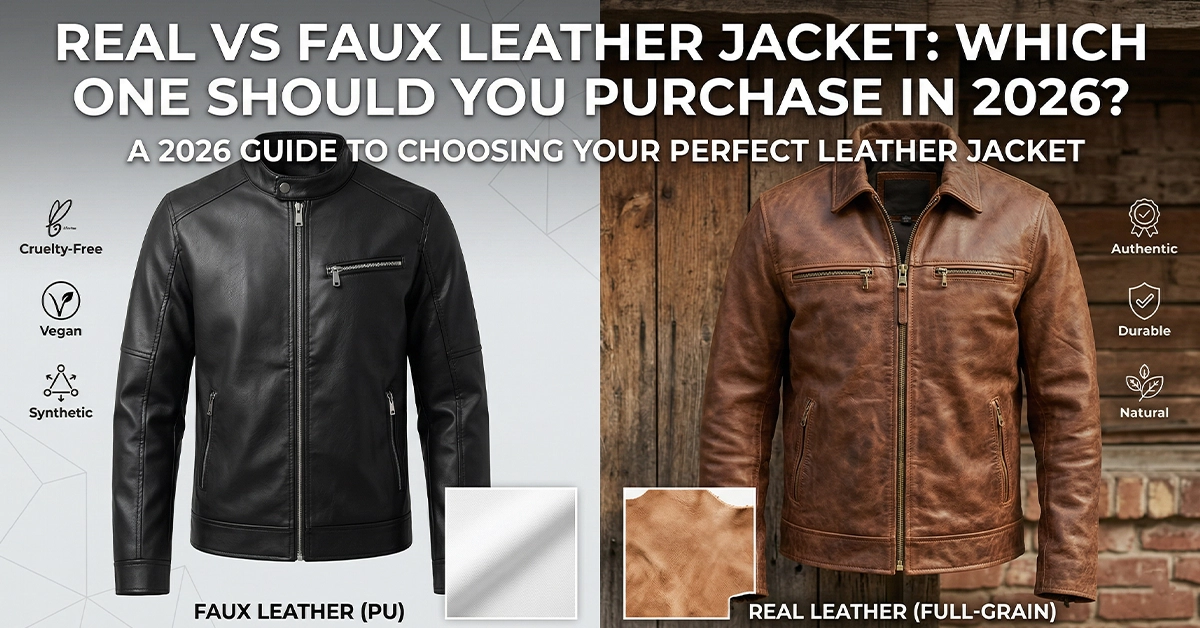
Real vs Faux Leather Jacket: Which One Should You Purchase in 2026?
- Quick Comparison: Real Leather vs Faux Leather
- What Is Real Leather?
- What Is Faux Leather?
- Real Leather vs Faux Leather: Detailed Comparison
- Choosing Based on Season
- Choosing Based on Lifestyle
- Choosing Based on Budget
- Common Mistakes Buyers Make
- Leather Jacket Trends in 2026
- Final Verdict: Which One Should You Buy?
- Conclusion
The game is serious. A jacket in this category is not a spur of the moment purchase. Whether you are spending $80 on a PU biker or $600 on full-grain cowhide, you are committing to something you will wear for seasons, not just days. Getting the material wrong means either overspending on quality you did not need or watching a faux option crack and peel before the year is out. The distinction between real and faux leather, at the material level, not the surface level, is what makes the difference between a smart purchase and an expensive lesson.
Market has changed significantly. Fortune Business Insights has estimated the global faux leather market to be USD 37.59 billion in 2025, with the expected growth to USD 39.09 billion in 2026. Meanwhile, the larger leather goods market (led by a high demand in genuine leather) stood at USD 531.07 billion in 2025. Both categories are growing, which tells you something important: there is no single winner. The correct decision will be based on the buyer, the purpose and the methodology. This guide gives you the full picture.
Quick Comparison: Real Leather vs Faux Leather
This table can be used as a guide before getting down to the detail.
| Feature | Real Leather | Faux Leather |
|---|---|---|
| Durability | Lifespan of 10–30+ years with good care. | Usually 2–5 years prior to peeling. |
| Price | $150–$1,000+ | $30–$200 |
| Comfort | Moulds to body over time; breathable. | Lightweight but can feel stiff initially. |
| Breathability | Naturally breathable; regulates temperature. | Traps heat; poor circulation. |
| Maintenance | Needs conditioning; small scratches heal by themselves. | Easy to wipe; cannot repair peeling. |
| Sustainability | Extended life span minimizes waste; tanning is a cause of concern. | Animal-free; PU/PVC production has own environmental costs. |
| Weather Suitability | Superb in cold and in-between seasons. | Performs better in mild weather; may crack in very cold weather. |
| Aging | Grows deep patina; gets better with age. | Fades and peels; appearance degrades. |
What Is Real Leather?
Real leather is made out of animal hides, usually cowhide, which are tanned and worked to create a tough, pliable material. It is not a single standard product. The grade of real leather varies significantly, and that grade determines everything from texture to lifespan. To know what you are purchasing, it is a good place to start by exploring the different types of leather jackets and their connection to the grade of material.
Full-Grain Leather
The best quality is full-grain leather. It preserves the whole exterior of the hide, with natural flaws. It is the strongest, most breathable and the most costly option. With years of use it acquires a rich, deep patina – a quality of surface that, in fact, becomes better as it wears, and causes the jacket to be truly worn in, but not worn out.
Top-Grain Leather
Top-grain leather is sanded and then coated with a finish. This is the grade that you see in most of the fine retail jackets. It looks less rugged than full-grain and a little less durable, yet remains a great long-lasting material.
Genuine Leather
True leather – even though it sounds impressive – is the poorest quality of real leather. It is produced out of the bottom stratum of the hide that has been stripped off. It is real leather in the technical sense, but it does not perform or age like full-grain or top-grain. When a listing states that it is only genuine leather, without any additional specification, inquire.
In every grade, real leather is naturally breathable, feels soft and shapes to the body with time, and has a durability that synthetic materials can never match. A good leather jacket that is well maintained can be used over decades. That is not a sales claim – it is the reason vintage leather holds its value.
What Is Faux Leather?
Faux leather – also called synthetic leather, vegan leather, or imitation leather – is a man-made material engineered to replicate the look and, increasingly, the feel of genuine leather. There are two dominant types in the market today.
PU Leather (Polyurethane)
The more common of the two is PU leather (polyurethane). A fabric base is coated with polyurethane to create a soft, lightweight, and relatively convincing material on the surface. Most mid-range faux leather jackets are made out of PU leather, which has been getting much better in quality in recent years.
PVC Leather (Polyvinyl Chloride)
PVC leather (polyvinyl chloride) is less flexible and usually less expensive. It is more waterproof than PU but also less breathable and more prone to cracking in cold temperatures. PVC is used more in cheaper accessories than in jackets, but is found in low-end outerwear.
In 2025 and 2026, there has been actual material innovation in the faux leather category. Plant-based substitutes such as products based on cactus, mushroom mycelium, and apple waste are becoming popular among the brands that aim at sustainability-oriented consumers. These bio-based fabrics provide a solution to a portion of the environmental issues related to the production of PU and PVC, but remain a minor and high-priced portion of the larger faux leather market.
The core advantages of faux leather remain what they have always been: lower price, animal-free production, and consistent appearance. Faux leather is a valid and even more promising alternative to buyers with a fixed budget or with ethical issues regarding animal products.
Real Leather vs Faux Leather: Detailed Comparison
Durability & Longevity
Here the difference between the two materials is the greatest. A well-maintained real leather jacket – full-grain or top-grain – will last 15 to 30 years. The substance does not deteriorate like synthetics do; it grows old and obtains character. Scratches are frequently buffed out. The leather remains soft with conditioning.
Faux leather, on the contrary, has a predetermined life span. PU leather can last between two to five years of normal wear before the surface coating starts to peel or crack. Once that begins, it becomes irreversible. It is the most crucial material difference that buyers find out after it is too late.
Real leather is more cost effective in the long run as it is more practical in daily wearing or heavy use. In the case of occasional wear or fashion-conscious items that will be out of the wardrobe in a few seasons anyway, the shorter lifespan of faux leather will be less critical.
Comfort & Breathability
Real leather is a natural material that breathes. It permits air circulation and naturally controls the temperature to a certain degree, and that is why it can work well in a variety of seasons. It also fits the body with time – a true leather jacket worn for a year fits differently and better than when new.
Faux leather does not breathe as such. The artificial coating is a protective barrier that entraps moisture and heat. This is evident in hot weather or when in a high activity environment. The difference is not as evident on cold days, but when it is hot or when the jackets are worn energetically, faux leather jackets may be stifling.
Real leather also tends to feel more substantial without being heavy. The density of the hide (which is natural) gives it a property that PU, which is often supported by thin cloth, can hardly match.
Style & Appearance
The visual depth and texture of real leather are difficult to duplicate with synthetic material. Styling a black leather jacket in real leather feels different to the one in PU – it has a weight and personality that a layperson can feel. The patina of years of wear on full-grain leather is one of the most sought-after attributes of outerwear; it is wear damage reversed, it is gained texture.
Faux leather is a material with a consistent look. It appears to be the same but remains the same – it does not grow character. That consistency is a virtue to some aesthetics: the slick and minimal jacket in matte PU can appear sharp without the scruffy look that some consumers do not desire. But it will be no prettier in three years than it is today. Browse the leather jackets collection to see how the material variety translates into distinct aesthetics across styles.
Real leather also takes colour differently. Brown, tan, and burgundy rich tones develop additional depth over time. These colours can be recreated by faux leather initially, yet the surface covered does not react in a similar manner to light and wear.
Price & Value
The initial price of genuine leather is considerably higher. Entry-level genuine leather jackets start at around $150 to $200 for top-grain options, with full-grain and premium hides running $400 to $1,000 or more. Faux leather jackets are available from $30 at the budget end to around $200 for well-made PU options.
When the picture is viewed as a cost-per-year calculation, the picture changes. A $600 full-grain leather jacket that lasts 20 years works out to $30 per year. A $100 faux leather jacket that lasts three years costs $33 per year – and requires replacement. Real leather is not necessarily the expensive option when longevity is factored in; it is an upfront investment that spreads over time.
With that said, not all buyers are able to take in a purchase of $400 or $600 at a single time. A quality PU jacket can be a valid short-to-medium-term purchase to buyers with a set budget, so long as the expectation upon purchase meets the realistic life of the material.
Sustainability & Ethics
This is the most contested dimension of the comparison, and it does not resolve neatly in either direction.
The faux leather is cruelty-free, which will respond to the main ethical issue of a large portion of consumers. It also tends to have a lower upfront carbon cost per unit. Nevertheless, PU and PVC are petroleum-based materials, which can hardly be recycled and cause microplastic pollution because they form upon degradation.
The animal hides used in real leather are usually a by-product of the meat industry. The environmental impact is very dependent on the tanning process involved – vegetable tanning is much more environmentally friendly than chromium tanning, which is the standard used in lower-cost production. A real leather jacket that lasts 25 years has a far lower per-year environmental footprint than a faux jacket replaced every three. Custom Market Insights estimates that the vegan leather market will expand at a CAGR of 10.8% through 2034, driven by demand for plant-based leather alternatives like mycelium and cactus leather that help to overcome the petrochemical issues related to PU.
Both materials are not eco-neutral. The more sincere version would be that real leather, purchased once and worn over decades, is a more sustainable personal purchase than cycling through a variety of synthetic jackets – but only insofar as the consumer is prepared to make the long-term commitment.
Choosing Based on Season
One of the most neglected aspects when purchasing a leather jacket is the season, which alters the material calculation significantly.
Winter
The more robust choice is real leather. It offers superior insulation compared to PU, especially with shearling or quilted interiors. Men’s leather jackets in full-grain or top-grain handle cold and wind far more effectively than synthetic equivalents. In extreme cold, faux leather becomes hard and is likely to crack at stress areas.
Summer
Both are not the best to wear in hot weather, but faux leather is lighter. Direct sun can make real leather very hot. When purchasing for the summer season, you should seek lightweight construction and open linings in either material.
Spring and Autumn
This is the season when leather jackets – real or faux – are in their prime. Both materials are practical due to their layering potential and wind resistance. Women’s leather jackets in transitional-weight real leather are especially versatile during such seasons and can be worn during unexpected rain and cold mornings without the heavy burden of a coat.
Choosing Based on Lifestyle
Your material selection should be influenced by your day-to-day life, just as much as by your budget.
Daily Wear
When you are wearing a jacket on a daily basis, you should invest in real leather. The material handles repeated use without deteriorating the way faux leather does. In five years, a good biker jacket made of real leather worn every day will not be worse-looking, but characterful.
Occasional Wear
When the jacket is going to be worn on evenings out, seasonally or for certain occasions in place of daily rotation, then faux leather can be considered. The reduced frequency of use implies that the material life is not a major issue.
Travel
Real leather is more resilient in varied conditions and does not show wear from packing or heavy use the way PU can. Real leather is more reliable for frequent travellers who desire a single jacket to deal with various weather conditions and events.
Professional Settings
Real leather reads as more polished in professional or semi-formal environments. A perfectly cut top-grain leather blazer jacket can be said to have an authority that cannot be easily portrayed using synthetic materials.
Choosing Based on Budget
The budget can be the determining factor, and there is nothing wrong about it. It is all about what each price level is capable of giving.
Under $100
At this price, you have faux leather. Expect PU construction, lightweight feel, and a lifespan of one to three years with regular use. Treat it not as a regular staple but as a seasonal item.
$100-$200
This is the price range of the more desirable faux leather products and the more affordable genuine leather. A good PU jacket can be a decent purchase at this price range for casual or occasional use. Authentic leather in this category will be genuine-grade hide, not top-grain.
$200-$500
This is the actual entry point for quality real leather. Top-grain options can be had at this level, and the investment would start to have a long-term financial payoff.
$500 and Above
Full-grain leather, high quality hides, and crafted construction. This is the long-term investment level. If you are buying once and keeping the jacket for a decade or longer, this is the category that delivers.
Common Mistakes Buyers Make
- Choosing based on price alone: Lowest priced faux leather is not necessarily the most cost-effective. Consider anticipated lifespan and compare prices.
- Ignoring climate: A PU jacket that breaks in the cold or is stifling in the warm is not worth buying no matter how nice it looks in the store.
- Not checking leather grade: “Genuine leather” is no guarantee of quality. Always check whether a real leather jacket is full-grain, top-grain or genuine-grade. The difference in lifespan is significant.
- Falling for low-quality faux leather: Faux leather is not all the same. Budget PU with a thin coating peels within months. Look for thicker PU construction and quality lining before buying.
- Buying for aesthetics alone: Style is important, but a jacket that you cannot wear comfortably or that disintegrates in a season is not a good purchase. The decision should give equal weight to material performance.
Leather Jacket Trends in 2026
The leather jacket category in 2026 is being shaped by several converging forces that affect both materials and design direction. The vegan leather market alone is projected to grow from USD 11.07 billion in 2025 to USD 27.80 billion by 2034 at a CAGR of 10.8%, driven by demand for plant-based alternatives from eco-conscious consumers.
Rise of Plant-Based Vegan Leather
Cactus, mycelium and apple-based leather are leaving the novelty stage and entering the real marketplace. These materials begin to address the petrochemical concerns attached to PU and PVC production, and appeal to consumers who wish to avoid both animal products and synthetic polymers.
Sustainable Tanning Processes
In the world of real leather producers, vegetable tanning and reduced-chemical processing is on the increase as both regulatory and consumer pressure drive the industry toward cleaner production techniques.
Longevity Over Trend Cycles
There is an increasing number of buyers in 2026 who are actively opposed to fast fashion cycles. The interest in genuine leather – especially full-grain – is partly driven by a desire to buy once, buy well, and keep a jacket for years rather than replacing synthetic options season after season.
Minimalist Design
Clean silhouettes, tonal palettes, and uncluttered hardware are dominating leather jacket design across both real and faux categories. The focus is on timeless cuts – biker, bomber, and moto – that are not limited to one season.
Final Verdict: Which One Should You Buy?
There is no universal superiority of the two materials. The right answer depends on your specific circumstances – and pretending otherwise does not serve you as a buyer.
Buy Real Leather If:
You want a jacket lasting ten or more years, you wear jackets frequently, you care about comfort and natural breathability and can afford the initial price. Real leather is the better long-term investment in both quality and value. Browse through the collection of real leather jackets for men and women’s leather jackets to discover the type of jackets that are in line with your real dress code.
Buy Faux Leather If:
Your budget dictates it, you want an animal-free product, or you need it due to a particular trend or seasonal use and not to be on rotation. A decent PU jacket can provide you with style and wearability of two to four years – should you not go with the lowest-cost option out there.
When cost permits and you are purchasing for daily use, real leather beats it on all long-term metrics. In case you are led by your ethics, price or occasional wear, a quality faux leather jacket is a valid and even more competent alternative.
Conclusion
There is no one right answer to the real leather vs faux leather debate – there is a right process. Begin with your budget and frequency of wearing the jacket. Then add in climate, intended use and the weight you put on long-term value versus upfront cost. The four inputs will lead you to the correct material.
The important thing is to purchase based on complete information and not sales conjectures. When a jacket is purchased at the correct grade and maintained in the proper manner, it is one of the most durable and versatile wardrobe investments you can make. A faux leather jacket purchased with realistic assumptions of durability is an excellent short-to-medium-term purchase. Explore the entire range of leather jackets at Jacketstown to discover choices in both types, including classic biker cuts and well-constructed faux alternatives, in both real leather and quality faux leather.