Blog
Polyester vs Leather Jackets: Pros, Cons & When to Choose Each
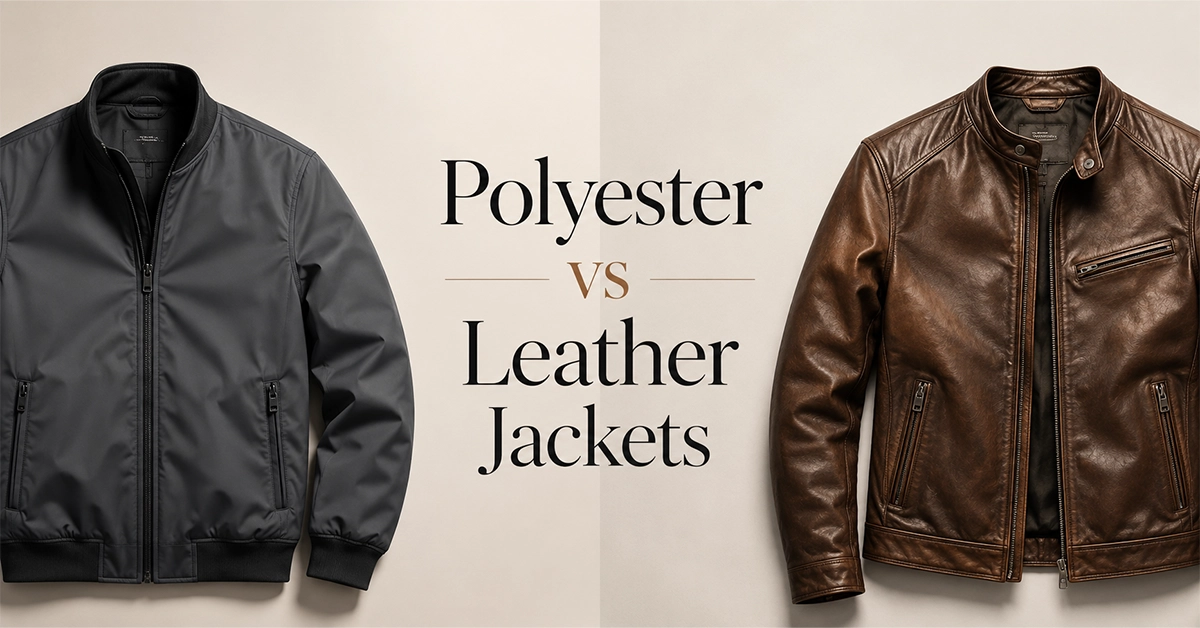
The differences between polyester and leather go well beyond price. We’re talking tensile strength, patina development, moisture behavior, breathability, and what either material actually looks like after three hard winters. A 2026 market study found that 73% of consumers are now planning to invest in higher-quality, longer-lasting wardrobe pieces rather than disposable trend items. That shift is real – and understanding why each material exists, what it does well, and where it completely fails is the only way to spend that money correctly.
At Jacketstown, we carry serious versions of both. Not cheap plastics. Not corrected-grain scraps. This isn’t a pitch for one or the other – it’s the honest breakdown you need before you click “add to cart.”
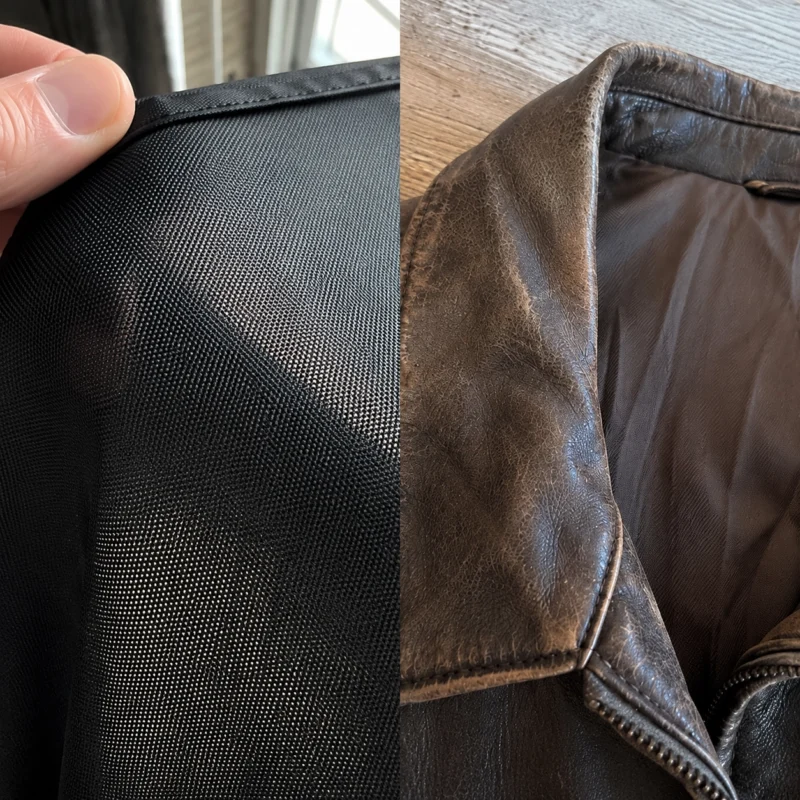
Quick Comparison: Polyester vs Leather Jacket at a Glance
| Feature | Top-Grain Leather | High-Grade Polyester |
| Durability / Lifespan | 15–20+ years; develops rich patina with wear | 3–7 years; UV and flex fatigue degrade the shell |
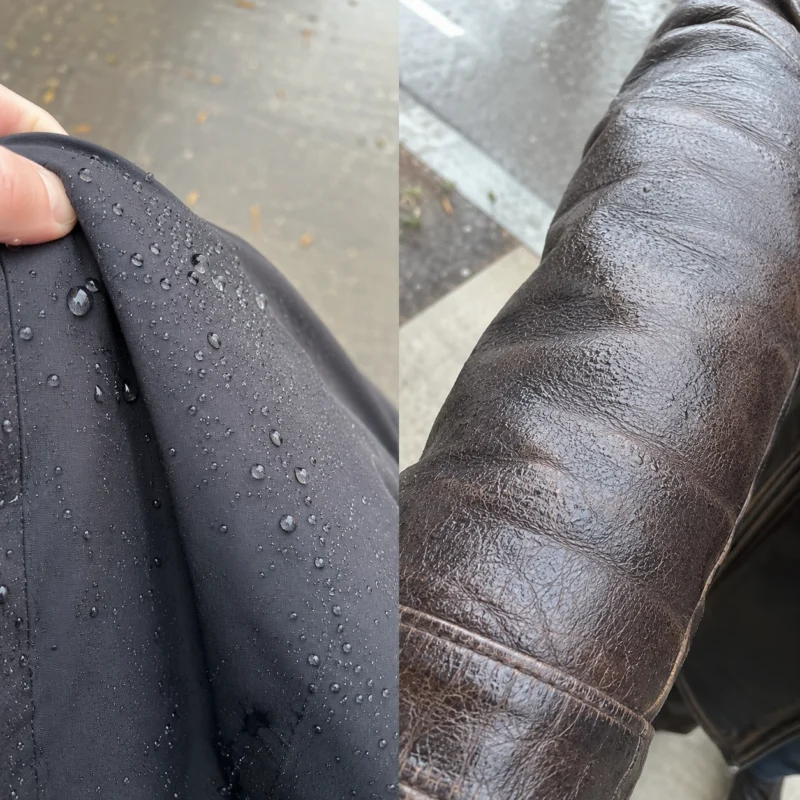
| Rain Resistance | Repels light rain; needs conditioning for heavy rain | Excellent – high-denier weave + DWR sheds water aggressively |
| Windproofing | Outstanding – dense hide stops cold air almost completely | Good to very good; varies by denier rating and construction |
| Breathability | Naturally porous – moisture vapor escapes through the hide | Poor without a breathable membrane; traps heat and sweat fast |
| Cost-to-Value Ratio | High upfront; extremely low cost-per-wear across a decade-plus | Low entry price; higher long-term cost due to replacement cycles |
Polyester vs Leather Jackets: The Head-to-Head Breakdown
Durability & Lifespan: One Ages, One Expires
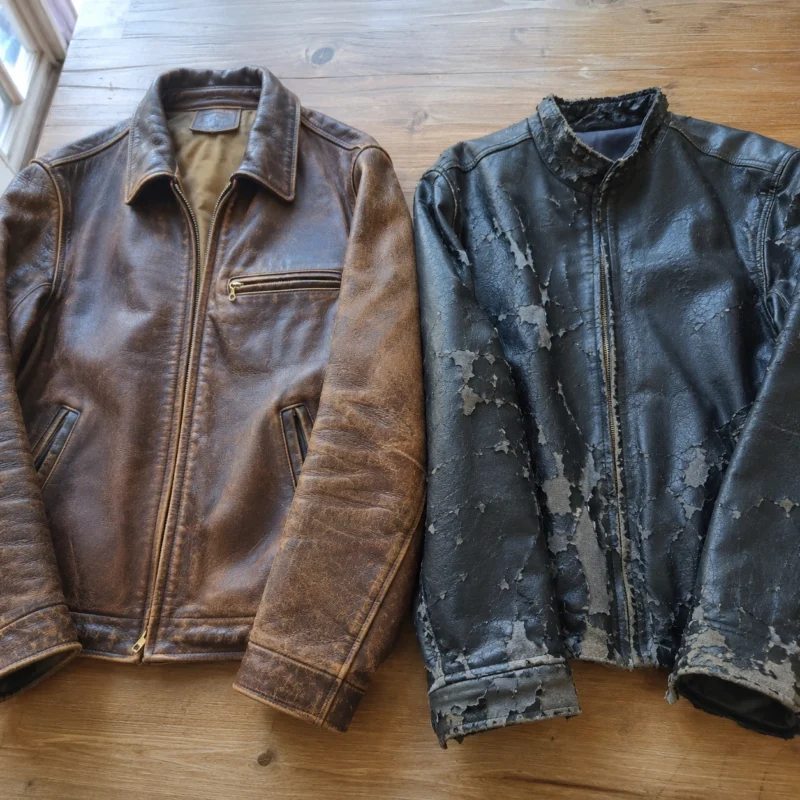
Top-grain leather is a structural material. The hide’s natural fiber network – collagen woven at multiple angles – gives it tensile strength that synthetic weaves simply cannot replicate. A well-maintained leather jacket doesn’t just survive; it transforms. The surface darkens and softens at the creases, the grain tightens around stress points, and the whole garment maps itself to your body over years. The average lifespan of a genuine leather jacket is estimated at 15 to 20 years. A quality men’s leather jacket can realistically outlast multiple cars.
Polyester ages differently. UV exposure breaks down the polymer chains. The PU-coating on synthetic “faux leather” versions begins peeling at high-flex zones – cuffs, elbows, underarms – typically within two to four years. Even a well-constructed high-denier woven shell will start losing its DWR (durable water repellent) treatment, pilling at friction points, and delaminating at seams long before a leather jacket shows any structural stress. For men’s biker leather jackets specifically – where abrasion resistance against tarmac is a genuine safety consideration – there is no honest synthetic alternative at standard market price points.
Buying a $60 polyester jacket every two winters because the zipper housing cracks isn’t budget shopping. It’s a subscription to bad outerwear.
Weather Combat: It Depends Which Weather You’re Fighting
Polyester wins a rainstorm. High-denier synthetic weaves – 300D and above – shed water aggressively, and with a factory-applied DWR coating, a good polyester shell turns precipitation into nothing. Water beads up and rolls clean off the surface in sheets. For commuters navigating heavy rain or hikers caught above the treeline, a technical polyester shell is genuinely the superior tool for acute wet conditions. It’s the best jacket for rain in a strictly functional contest.
Leather, untreated, absorbs water in a prolonged downpour. This is not a flaw – it’s physics. Leather is a naturally porous material; that same porosity is what makes it breathe and flex. A quality leather conditioner or beeswax treatment creates a reasonable barrier, and in light rain, top-grain hides shed moisture well. But the real advantage leather holds in weather? Wind. The dense, non-woven structure of a full-grain hide creates a cold-air barrier that no woven synthetic matches at comparable thickness. In freezing wind – city winters, open highways, mountain passes – leather stops the air in a way that polyester panels simply cannot.
Aesthetics & The Vibe: Drape, Structure, and What the Jacket Tells the Room
Leather has a structural drape. A broken-in cowhide jacket holds its shape, falls with authority, and moves as a unit – not a loose shell billowing in the wind. The weight of the hide (typically 0.8mm to 1.2mm for fashion weight, up to 1.5mm for moto) gives the wearer a composed, unruffled silhouette. Brown leather jackets and classic black hide develop distinct visual characters over time – the patina darkens at stress points, lightens at ridge edges, and tells a story no two jackets ever tell the same way. That’s authenticity you actually wear.
Polyester jackets are lightweight and technical by nature. A well-cut synthetic shell can look sharp – especially quilted or tailored constructions – but they lack the material gravity of genuine hide. They also look the same at year one as they do at year three, which is either an advantage or a sign that nothing interesting is happening to the material. There’s a reason aviator jackets in leather have anchored wardrobes since the 1920s. The form follows the function of the hide, and that relationship doesn’t date.
The Sustainability Reality: No Easy Hero Here
Both materials carry environmental debt. Full stop.
Polyester is a petroleum product. According to the Textile Exchange’s 2025 Materials Market Report, global fiber production hit a record 132 million tonnes in 2024, with polyester now making up 59% of that output – 88% of which comes from fossil feedstocks. Critically, only 1% of polyester is currently recycled into new textiles. The vast majority ends up incinerated or landfilled, with polyester taking centuries to decompose and shedding microplastics throughout its entire life cycle – including every wash cycle.
Leather is a byproduct of the meat and dairy industry – it does not drive animal slaughter directly, but the tanning process involves significant chemical loads, high water consumption, and chromium waste when unmanaged. Vegetable-tanned and LWG-certified tanneries have improved considerably, but it is not a clean process at industrial scale.
The sustainability argument ultimately lands on longevity. A leather jacket worn for 15 years carries a fraction of the per-year carbon footprint of three polyester jackets cycled through the same period. Cost-per-wear and garment lifespan are the most honest sustainability metrics available – and on those, leather wins without debate. The global leather jacket market was valued at USD 37.23 billion in 2025, driven in significant part by consumers who have already figured this out.
When to Choose a Polyester or Leather Jacket
Buy Polyester When:
- You need a packable, lightweight shell for hiking, travel, or daily commuting that compresses into a bag without wrinkling or adding real weight.
- You’re dealing with sustained, heavy rainfall and want genuine waterproof performance without conditioning and treating the jacket. A sealed synthetic shell is a better wet-weather tool, full stop.
- Your budget is strictly under $150 and you understand you’re buying something functional rather than generational.
- You need active-wear mobility – stretch panels, articulated elbows, moisture-wicking performance in an athletic or high-exertion context. Browse men’s polyester jackets or women’s polyester jackets for options built with actual construction integrity rather than fast-fashion shortcuts.
- Vegan or animal-product-free is a firm requirement. High-grade polyester is the honest choice – not PU-coated synthetics marketed as “vegan leather,” which are just plastic with branding.
Buy Leather When:
- You want a jacket you can hand to your kid in 20 years and have it look better than the day you bought it. That’s not marketing copy – that’s what full-grain leather actually does.
- Wind is your primary enemy. Urban winters, motorcycle riding, exposed coastal environments. Leather’s dense hide structure eliminates windchill at the surface in a way no woven synthetic matches without heavy additional lining.
- You want real abrasion resistance. Against pavement, rough surfaces, or daily friction that destroys synthetic shells quietly and without warning.
- Style matters long-term and you want it to hold. A classic leather silhouette – women’s leather jackets or men’s – doesn’t go out of fashion the way a seasonal synthetic colorway does.
- Cost-per-wear matters more to you than sticker price. Run the math: a $380 leather jacket worn 80 days a year for 15 years costs roughly $0.32 per wear. A $90 polyester jacket replaced every three years runs to approximately $0.38 per wear – and that’s before you factor in the inconvenience of replacement shopping.
Polyester vs Leather Jacket FAQs
Which is warmer: leather or polyester?
Leather is the stronger windbreaker of the two – and windchill is the dominant factor in how cold you actually feel. A full-grain hide blocks airflow almost completely, while most polyester shells require a separate thermal lining to achieve equivalent warmth. That said, both materials rely heavily on their linings for real insulation; a leather jacket with a thin nylon lining will be colder than a padded polyester shell. Think of it as shell performance versus lining system – both variables matter, but leather wins the leather jacket breathability and wind-resistance round decisively.
Can a polyester jacket look like real leather?
Briefly, and poorly. The moment a PU-coated polyester jacket flexes, bends, or is held up to light, the synthetic weave becomes apparent – no grain variation, no pore structure, no subtle texture differences between panels. It also smells different. High-end nubuck-textured polyester has improved, but calling PU-coated synthetic “leather-look” is generous. The crinkle behavior under cold temperatures is entirely different from genuine hide, and anyone who has owned both will spot the difference in under ten seconds. PU leather is plastic. Market it as plastic.
Which is easier to wash and maintain?
Polyester wins on convenience. Most polyester shells are machine washable – cold water, gentle cycle, air dry – and require virtually no seasonal care. Leather requires conditioning every few months with a quality leather cream or beeswax product, occasional saddle soap cleaning for surface grime, and proper storage away from direct heat, which dries out the hide and causes cracking. The maintenance is not difficult, but it requires engagement. If you want a jacket you never think about, polyester is your material. If you can spare 20 minutes twice a year, leather rewards the effort for decades.
Is a leather jacket worth the higher price? What about cost-per-wear?
On cost-per-wear, yes – almost always. The cost-per-wear calculation favors leather at any serious volume of use. A $400 leather jacket worn 80 days a year for 15 years costs roughly $0.33 per wear. A $90 polyester jacket replaced every three to four years runs higher than that before you factor in the time and effort of replacement. The question isn’t whether leather is “expensive” – it’s whether your lifestyle justifies the upfront spend. For anyone who wears an outer jacket more than 50 days a year, it almost certainly does.
Does polyester breathe? Is leather breathable?
Standard woven polyester breathes poorly. The synthetic weave is hydrophobic by nature – it doesn’t absorb moisture – so sweat has nowhere to go without an engineered breathable membrane (like Gore-Tex or a proprietary laminate). Base-level polyester traps body heat and moisture fast under aerobic conditions. Leather, by contrast, is naturally porous – moisture vapor can escape through the hide in a way that synthetic weaves cannot replicate without expensive membrane technology.
Which handles cold temperatures better: synthetic vs genuine leather jacket?
In sub-zero wind, leather’s structural density wins. It eliminates windchill at the surface in a way that woven synthetic vs genuine leather jacket comparisons consistently demonstrate. In wet cold specifically, a sealed polyester shell keeps moisture out longer without any additional treatment. A leather jacket conditioned with beeswax handles light freezing precipitation well, but it is not waterproof in any technical sense. The simplest answer: for dry, freezing cold, leather. For wet, cold conditions where wind is secondary, a treated polyester shell.
What is the polyester jacket lifespan versus leather?
A well-constructed high-denier polyester jacket from a reputable brand – not fast fashion – can last five to seven years with proper care. Budget synthetics show delamination, pilling, and zipper failure within two to three years. The variance is enormous and tied directly to construction quality, denier weight, seam treatment, and DWR durability. Leather, maintained properly, is estimated to last 15 to 20 years on average, with full-grain hides routinely outlasting that estimate. The polyester jacket lifespan conversation is really a quality conversation – there’s no meaningful average that applies across the entire synthetic category.