Blog
Halloween 2026: Exact Date, Samhain Origins, and the Shift to Everyday Cosplay
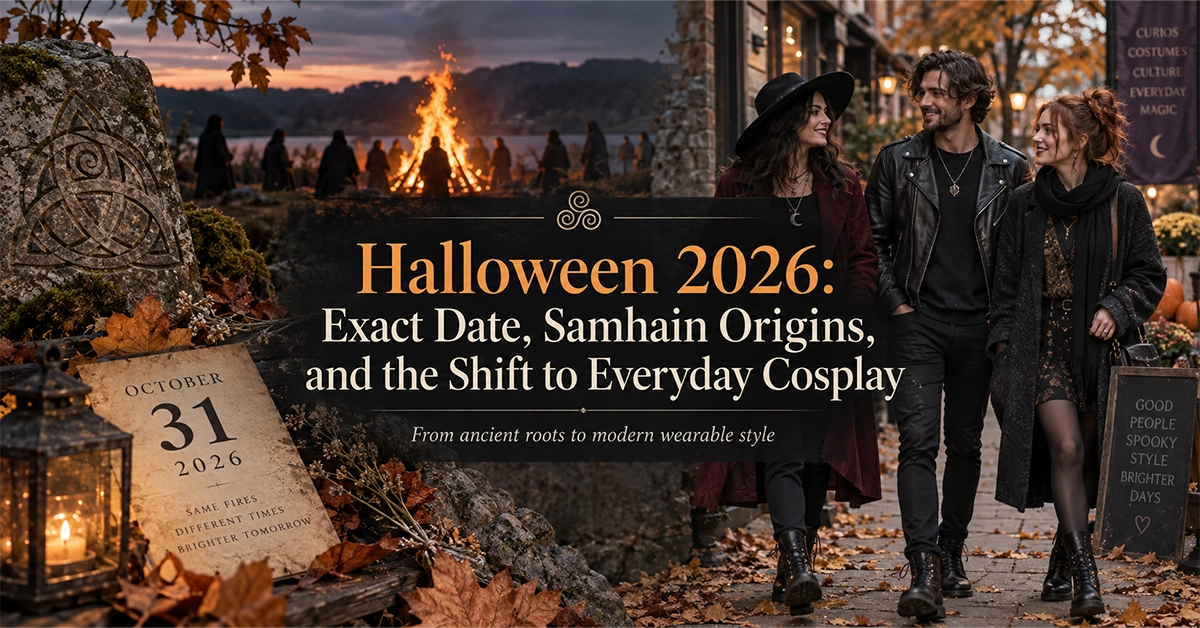
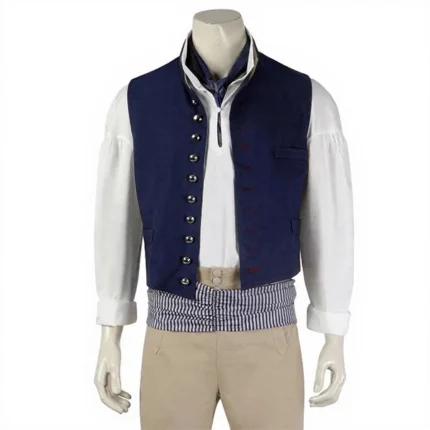
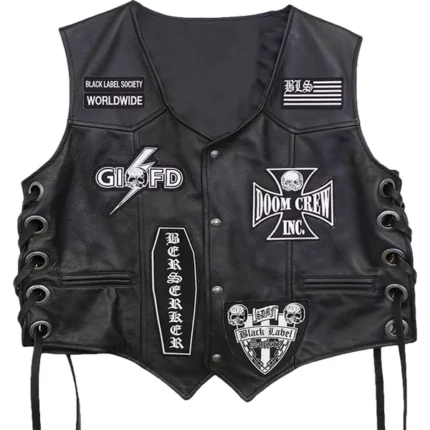
Quick Answer: Halloween 2026 falls on Saturday, October 31. Its traditions are partly associated with the ancient Celtic festival of Samhain, which marked the transition into winter and included customs connected with spirits, fires, and disguises. Modern Halloween blends these historical influences with costumes, parties, trick-or-treating, and pop-culture fandom. One contemporary approach is “Everyday Cosplay” – building recognizable character-inspired outfits around wearable pieces such as leather jackets, movie-inspired outerwear, boots, and accessories that can still be used after Halloween instead of relying entirely on single-use costumes.
Most Halloween guides recite the same ghost story every October: ancient Celts, thinning veils, a night for spirits. All true. None of it explains why so many people are showing up this year in a screen-accurate leather jacket instead of a bag costume from the drugstore aisle.
I’ve spent years watching Halloween buying patterns up close, on both the trend-analysis side and the outerwear-design side, and the two used to feel like separate industries. They aren’t anymore. A costume decision and an outerwear decision have quietly become the same decision for a growing number of shoppers, and most coverage of the holiday hasn’t caught up to that yet.
In my experience analyzing seasonal costume trends, the shift has been building for a few years and finally tipped in 2026. Search behavior around “Halloween costumes” has quietly split in two: one half still wants the cheapest thing that’ll survive one night, and the other half wants something that survives the whole winter. That second group is growing fast, and it’s why more buyers are choosing re-wearable leather jacket halloween costumes over disposable polyester suits that rip after one wear.
The pressure behind that shift is real and dated: roughly a quarter of Halloween shoppers had already bought at least one item for the holiday as of early August 2026, well ahead of the usual late-October scramble. People aren’t just shopping earlier. They’re shopping smarter.
Here’s what this guide actually covers: the exact date, the 2,000-year-old origin most people only half-remember, how costumes evolved from animal hides to 4K screen accuracy, and why burying a great costume under a winter coat is the most common mistake of the night.
The quick facts, before anything else.
| Detail | 2026 Answer |
|---|---|
| Date | Saturday, October 31, 2026 |
| Origin | Ancient Celtic festival of Samhain, with traditions dating back more than 2,000 years |
| Original Purpose | Disguises and related customs associated with spirits during the transition into winter |
| The 2026 Shift | Greater interest in re-wearable “Everyday Cosplay” and character-inspired outerwear instead of entirely disposable costumes |
The Core Shift From Disposable Bags to Everyday Cosplay
Why Search Behavior Around Costumes Has Changed
People used to search “cheap Halloween costume.” Now a growing share search for a specific jacket, a specific character, a specific look they can actually wear again. That’s not a small semantic shift. It’s a completely different buying decision, with a completely different bar for quality.
The Problem With the “Costume in a Bag”
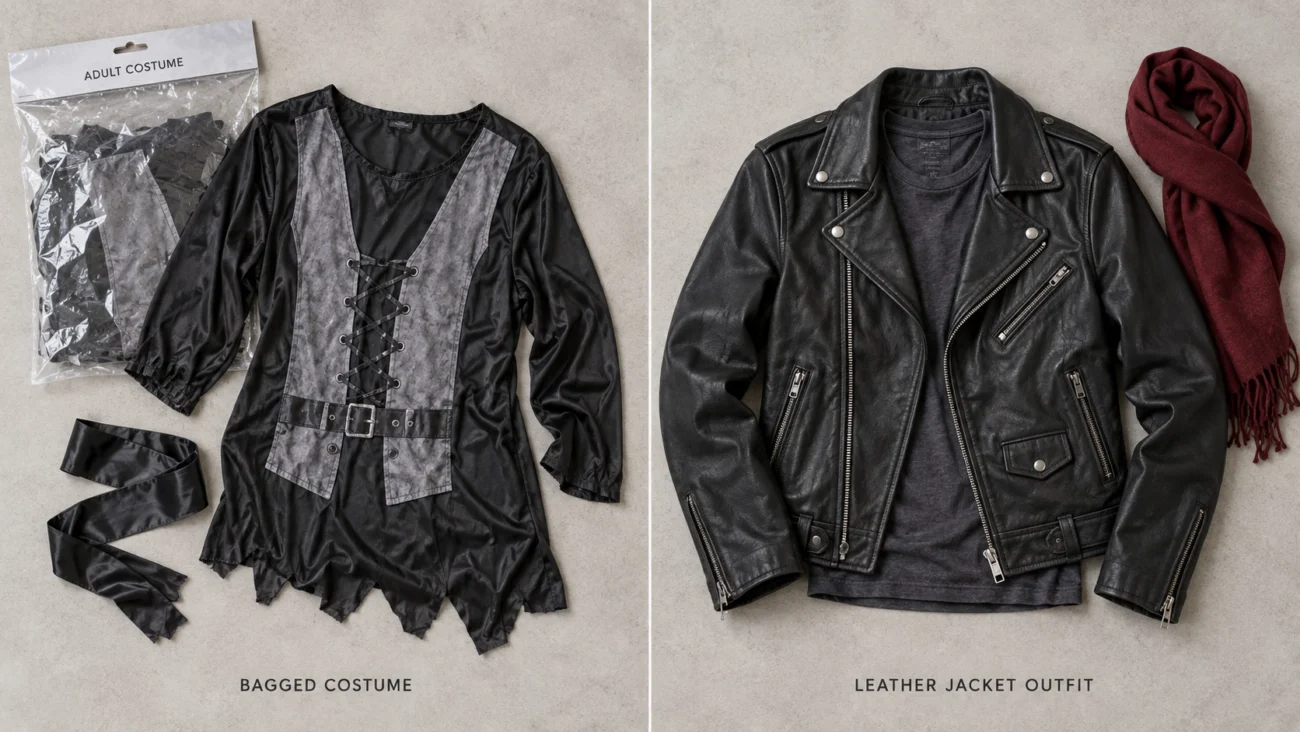
Here’s the painful truth about the “costume in a bag”: it’s built to survive exactly one night, and it usually doesn’t even manage that. Seams split during the first round of dancing. Thin synthetic fabric offers zero protection against a 40-degree walk home. And the second you take it off, it’s landfill, not wardrobe.
Movie Jackets as Both Costume Anchor and Daily Wardrobe Flex
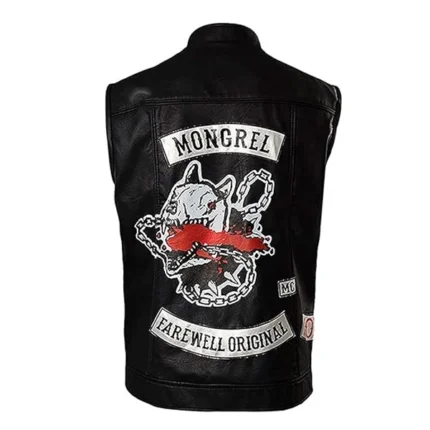
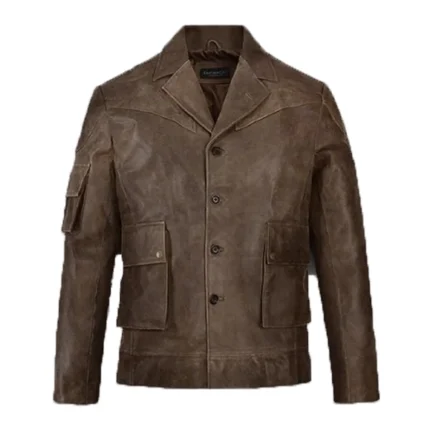
This is where the shift actually shows up in product choices. A Wolverine-style brown leather jacket reads as an instant costume anchor at a party and as a genuinely good jacket the next Tuesday. Same with a Michael Jackson-style red-and-black leather jacket pulled straight from the most famous music video of all time. Think about it: one purchase, a whole season of wear instead of one night of it. There’s a full roundup of movie jackets people are actually buying in 2026 if you want the wider list of what’s driving this.
The Ancient Origins – Samhain, Celtic Lore, and Spiritual Camouflage
Samhain and the Celtic Calendar
Why do we celebrate Halloween on October 31st specifically? Because that date marked the Celtic new year’s eve – the end of harvest and the start of the dark half of the year. Samhain sat exactly on that hinge point, and the Celts treated it as a genuinely dangerous night, not a festive one.
Why People Originally Wore Disguises
Here’s the part most guides gloss over: the original costumes weren’t decorative. They were spiritual camouflage. The Celts believed the boundary between the living and the dead thinned on that one night, and roaming spirits could cross over. Dressing in animal skins and soot wasn’t for fun. It was so a spirit would look at you and keep walking.
That single detail explains almost everything about why costuming persisted as a tradition for two thousand years while other Samhain customs faded. Bonfires eventually gave way to jack-o’-lanterns. Sacrificial offerings gave way to candy. But the act of disguising yourself survived nearly unchanged in function, even as its meaning shifted from genuine spiritual defense to community tradition to, eventually, pure entertainment.
How the Church Turned Samhain Into a Christian Holiday
By the 8th century, the Catholic Church had a problem it couldn’t simply out-preach: a pagan festival too deeply rooted in Celtic life to erase outright. The usual solution followed – absorb it. Pope Gregory III designated November 1st as All Saints’ Day, and within a century the observance had spread church-wide as All Hallows’ Day. The night before it, All Hallows’ Eve, inherited Samhain’s customs almost wholesale: bonfires, disguises, offerings for the dead, all relabeled under a Christian calendar instead of a Celtic one. Say “All Hallows’ Eve” fast and often enough across a few centuries and you land on “Hallowe’en.” Then “Halloween.” The name itself is a fossil of that merger, still carrying the shape of the words that got compressed into it.
The Original Jack-o’-Lantern Wasn’t a Pumpkin
Irish folklore tells of Stingy Jack, a man who tricked the devil twice and ended up barred from both heaven and hell when he died. Sent into the dark with nothing but a burning coal to light his way, Jack hollowed out a turnip to carry it, wandering the earth as a warning made root vegetable. Irish and Scottish families started carving their own turnips, potatoes, and beets into grotesque faces, hoping to ward off Jack’s spirit and others like him. When those same families reached America, they found a rounder, bigger, far easier vegetable waiting in the fields. The pumpkin won the job by default, and it’s been the holiday’s mascot ever since – a straight substitution, not an original American invention.
From Ireland and Scotland to North American Trick-or-Treating
Irish and Scottish immigrants carried these traditions across the Atlantic through the 19th century, and the door-to-door “guising” tradition slowly merged with American community customs, eventually settling into the trick-or-treating format most people recognize by the 1950s. The costume stayed. The spiritual urgency behind it mostly didn’t – until you look at how seriously some people now take getting the details right.
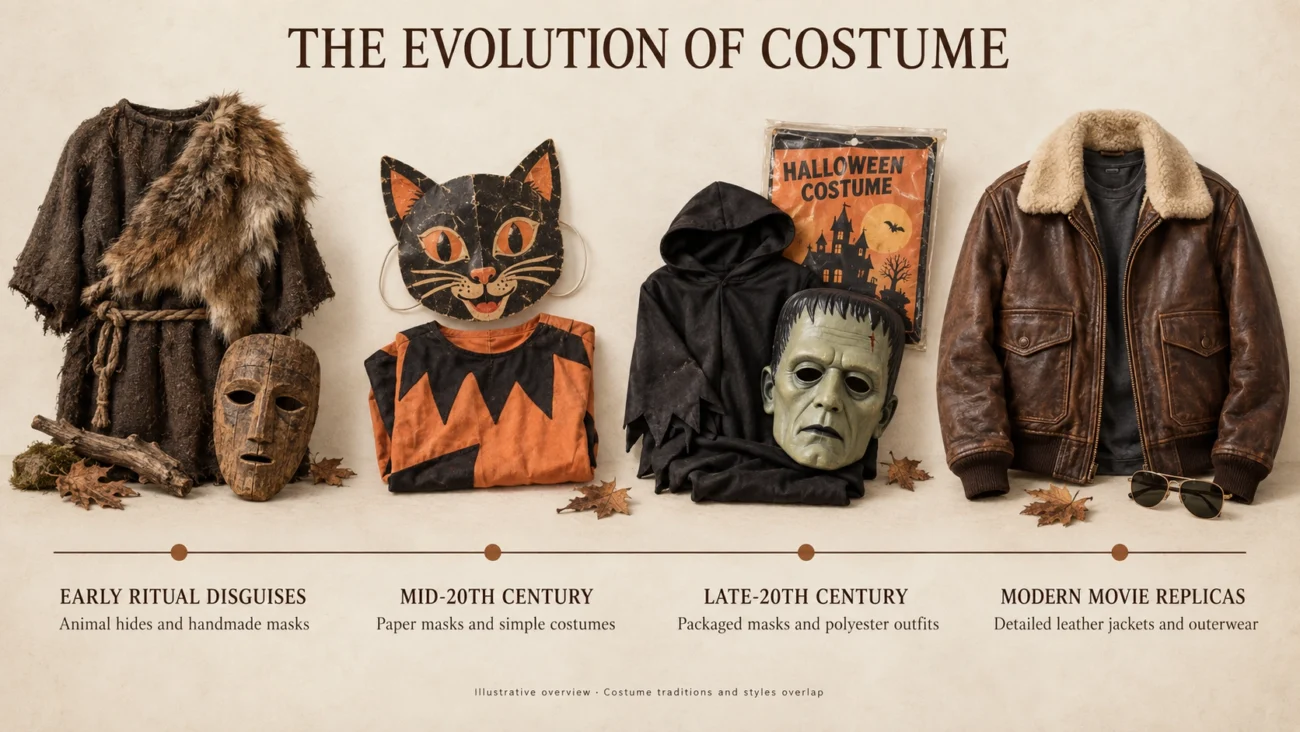
The Evolution of Costumes – From Pagan Skins to Screen Accuracy
Here’s the timeline most people have never seen laid out end to end.
| Era | What People Wore |
|---|---|
| The Pagan Era | Animal skins, soot-smeared faces, and masks made from materials such as bone and wood |
| Mid-20th Century | Inexpensive paper costumes and thin plastic masks, including the styles associated with the Ben Cooper era |
| Late 20th Century | Mass-market polyester costumes influenced by slasher films and other popular horror characters |
| 2026 and Beyond | High-fidelity character-inspired looks built around screen-accurate-style leather jackets and movie outerwear |
That last jump is the one worth sitting with. Costume-grade polyester dominated for decades because it was cheap to mass-produce for a single-use product. The current wave of genuine leather movie replicas exists because enough buyers finally decided a costume shouldn’t be disposable by design.
Zoom out far enough and the pattern is almost circular. Pagan-era costuming used real, durable materials because that’s all that existed – hide, bone, wood. The mid-century plastic-and-paper era was the actual anomaly, a decades-long detour into cheap and temporary. 2026’s shift back toward real materials isn’t a new idea. It’s the oldest idea in the holiday’s history, just with better tailoring.
A few specific turns are worth naming. Manufacturers like Ben Cooper and Collegeville dominated mid-century costuming with boxed sets sold at drugstores nationwide: a thin plastic mask on a rubber band, paired with a smock printed with the character’s likeness. Sugar rationing during World War II paused trick-or-treating in the U.S. almost entirely between 1942 and 1947 – there was nothing to hand out, so the ritual simply stopped for half a decade before picking back up once rationing lifted. Things stayed roughly unchanged until Hollywood found its way into the costume aisle. The late 1970s and 1980s turned licensing into the industry’s real engine: a single blockbuster could sell a million identical costumes off one movie poster. Fast forward to the 2000s and pop-up chains took that same licensing logic and scaled it into a business generating close to a billion dollars in seasonal revenue from stores that exist for six weeks a year and vanish for the other forty-six.
The October Weather Dilemma
Don’t Bury Your Costume Under a Puffer Coat
Here’s the cold reality: most of the country isn’t wearing a T-shirt on October 31st. Temperatures sitting around 40°F force a choice most people get wrong – they spend real money on a costume, then hide the whole thing under a generic black puffer the second they step outside.
I’ve watched this exact scenario play out at party after party: someone spends weeks planning a look, nails every detail, and then a cold snap turns the whole thing invisible under a shapeless coat for three hours. The costume technically exists. Nobody sees it.
The 40°F figure is a national average, and it hides real regional swings. Trick-or-treaters in the Northeast and Upper Midwest are routinely dealing with nights in the 30s, sometimes with an early frost already on the ground. The Pacific Northwest adds rain into the mix, which ordinary costume fabric handles even worse than cold does. The Gulf Coast and Southwest are the exceptions – a heavy jacket is often overkill there, not underkill. Wherever the reader falls on that map, the fix is the same: pick a costume that already assumes real weather instead of pretending Halloween happens indoors.
Outerwear-Based Costumes That Solve It
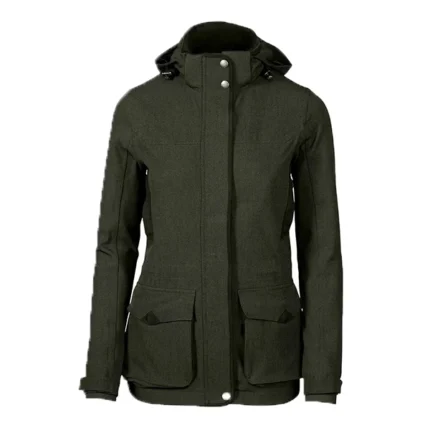
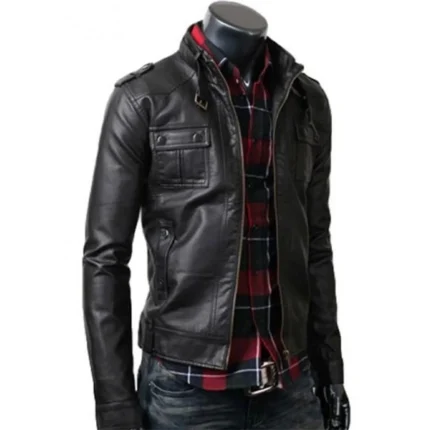
The fix is picking a costume that’s already outerwear. A flight jacket in the Top Gun Maverick style or a Stranger Things-inspired jacket solves the aesthetic and the warmth problem in the same purchase – no puffer coat required, no costume hidden for three hours at the actual party.

Party-Store Polyester vs. Investment Leather Replicas
What Polyester Actually Costs You
A cheap costume looks fine in a product photo and falls apart under a single dance floor. Multiply that by however many Halloweens someone celebrates, and “cheap” stops being cheap – it’s a new purchase every single year, landfill-bound each time.
Run the actual math over five years and the “budget” option stops looking budget at all. Five disposable costumes at even a modest price add up to more than one well-made jacket that’s still in the closet on year six – and still gets worn well past October.
The waste math is worse than most people assume, too. An estimated 35 million Halloween costumes get thrown away in the U.S. each year, and the overwhelming majority are built from non-recyclable, oil-based plastic that can take decades to break down once it’s in the ground. That’s not a hypothetical footnote. It’s the direct, physical result of treating a costume as single-use instead of as a piece of clothing.
The Case for Re-Wearable Leather
Genuine leather costs more up front and pays it back every winter afterward. Before you assume “genuine leather” always means what the listing claims, it’s worth understanding what actually separates real leather from a synthetic look-alike – the grain, the drape, the way it ages instead of cracking. That difference is the entire argument for investment over disposable.
The Shipping Tipping Point
The September Sweet Spot
Custom and replica leather pieces need real production time – cutting, stitching, finishing – before they ever reach a shipping label. Late September is the sweet spot precisely because it leaves room for that craft time plus standard shipping, landing well before the October 30-31 party weekend.
What Happens If You Wait
Wait past that window and you’re competing with every other category of holiday shopping for the same shrinking capacity. UPS, FedEx, and USPS have all confirmed higher peak season surcharges for 2026, starting as early as late September, which is the industry’s own way of admitting the system gets tighter every week after that. Order in the first half of October and you’re still fine. Order in the last week and you’re gambling.
None of this is unique to costume shopping – it’s the same congestion every retail category fights through in the run-up to the holidays. The difference is that Halloween has a single hard deadline instead of a flexible one. A late gift can arrive on November 2nd and nobody minds. A costume that arrives November 2nd missed the entire point.
FAQs
When is Halloween 2026?
Saturday, October 31st, 2026 – falling on a weekend this year, which typically means bigger parties and an earlier shopping rush than years when it lands midweek.
Why do we celebrate Halloween on October 31st?
The date comes from Samhain, the ancient Celtic new year’s eve that marked the end of harvest and the start of winter’s dark half, when the Celts believed the veil between the living and dead grew thin.
What is the history behind dressing up on Halloween?
Original costumes were protective disguise, not decoration – animal skins and soot worn so roaming spirits would mistake the wearer for one of their own. The custom evolved through masks, then mass-market polyester suits, into today’s screen-accurate outerwear.
When is the deadline to order custom Halloween outerwear?
Late September is the safest window, accounting for production and standard shipping. Ordering into mid-October still usually works; the last week of October is real gamble territory as carrier capacity tightens.
What are the best re-wearable jacket costumes for 2026?
Character-inspired leather jackets built around instantly recognizable film and TV looks – the kind that work as a costume anchor for one night and as an actual jacket for the rest of the season.
How much Halloween costume waste ends up in landfills each year?
Millions of costumes in the U.S. alone, the large majority built from non-recyclable, oil-based plastic that can take decades to decompose – a direct consequence of treating costumes as single-use rather than as wearable clothing.

- Harley Davidson11 products
 Brown Leather Jackets for Men and Women121 products
 Biker Jackets for Men and Women128 products
 Mens Jackets1019 products
 Spider-Man Leather Jackets & Character Styles12 products
 Men's Leather Jackets256 products
 Leather Jackets for Men and Women466 products
- Womens Denim Jackets9 products