Blog
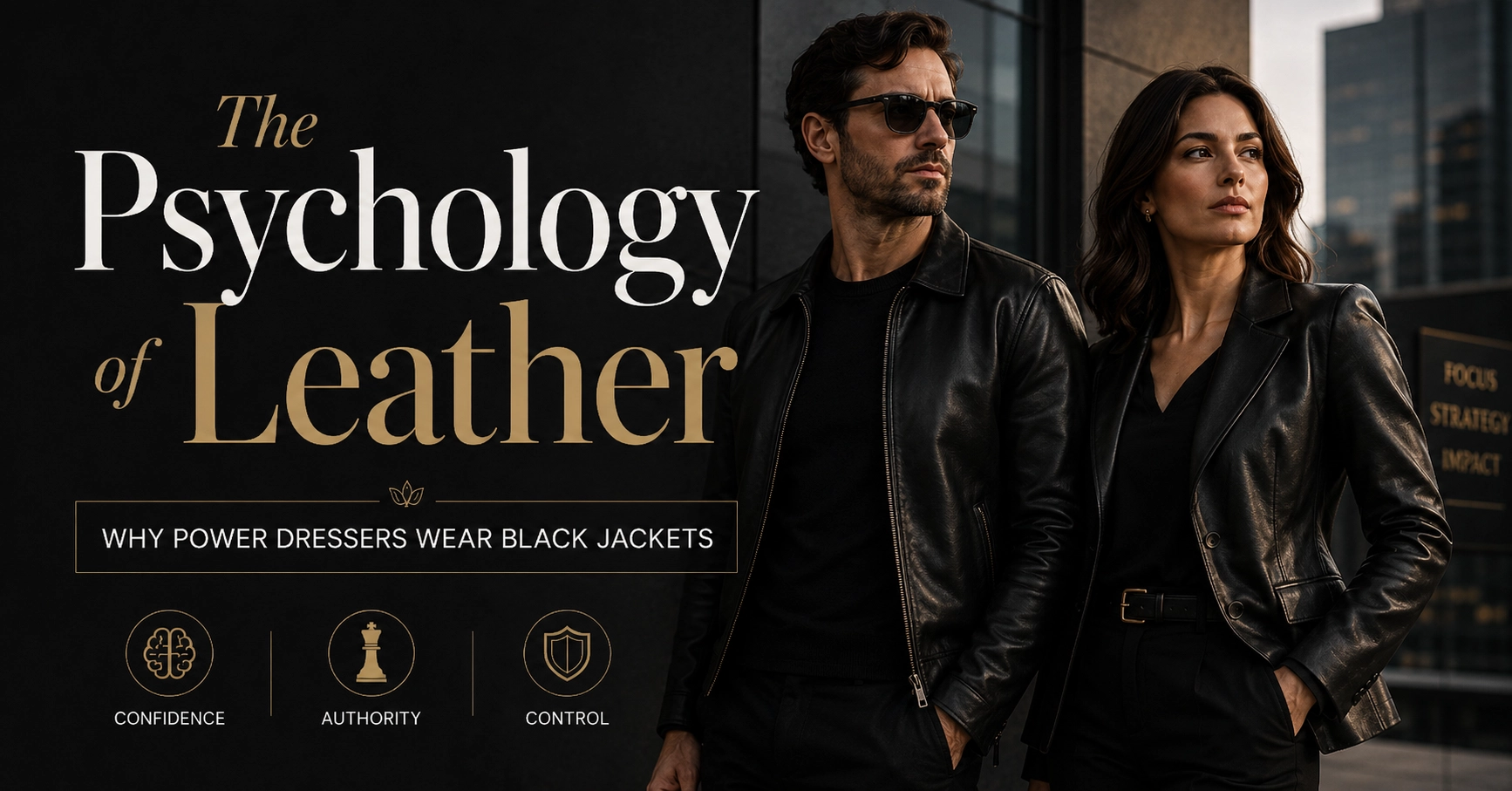
The Psychology of Leather: Why Power Dressers Wear Black Jackets
- What Black Really Says Before You Speak
- Leather as Modern Armor: Symbolism and History
- Enclothed Cognition: When Clothes Change Your Mindset
- How Others Read You: Person Perception and Power Dressing
- Why Power Dressers Love Black Leather Specifically
- Confidence in Practice: Before/After Moments and Micro-Rituals
- How to Use a Black Leather Jacket in Different Power Contexts
- Caveats and Healthy Boundaries: When Power Dressing Backfires
- FAQs
| WHY DO POWER DRESSERS WEAR BLACK LEATHER JACKETS? Power dressers reach for black leather for two reasons that compound each other. Black reads as authority, control, and seriousness in color psychology – it is the color judges, luxury brands, and corner-office executives all gravitate toward. Leather carries seventy-plus years of association with strength, resilience, and quiet rebellion, from WWII aviators to motorcycle clubs to the boardroom. Wear both at once and you trigger enclothed cognition: the documented psychological effect where what you put on your body changes how your brain shows up to the room. |
Imagine the closet five minutes before something that matters. A pitch. A first date that feels like an audition. A conversation you have been avoiding for three weeks. There is a soft knit on the left, forgiving and familiar. And then there is the black leather jacket, hanging slightly apart from everything else, like it knows something you do not yet.
Most people reach for it without thinking. Few stop to ask why.
Here is what actually happens, even if you have never put words to it: your spine straightens a half-inch before you have even zipped up. Your walk slows, just slightly – less scurry, more stride. You catch your reflection and something in your expression resets, quietly, before you have said a word. Psychologists studying self-presentation would call this a shift in posture and affect. You would probably just call it “feeling like yourself, but louder.”
This is not only in your head, either. The leather jacket market – black leather specifically leading demand – is valued at over $37 billion in 2025, and that growth has little to do with weatherproofing. It is about what the garment does to the person wearing it, psychologically, long after the fitting room. Psychologists have a name for the mechanism: enclothed cognition, the idea that clothes do not only broadcast something to whoever is looking at you, they change what is happening inside your own head. If you have felt sharper, harder to rattle, or oddly more decisive the second you zipped into a black leather jacket from Jacketstown’s collection, that was not vanity talking. That was a documented mechanism, and this piece is going to take it apart, piece by piece, so you can use it on purpose instead of by accident.
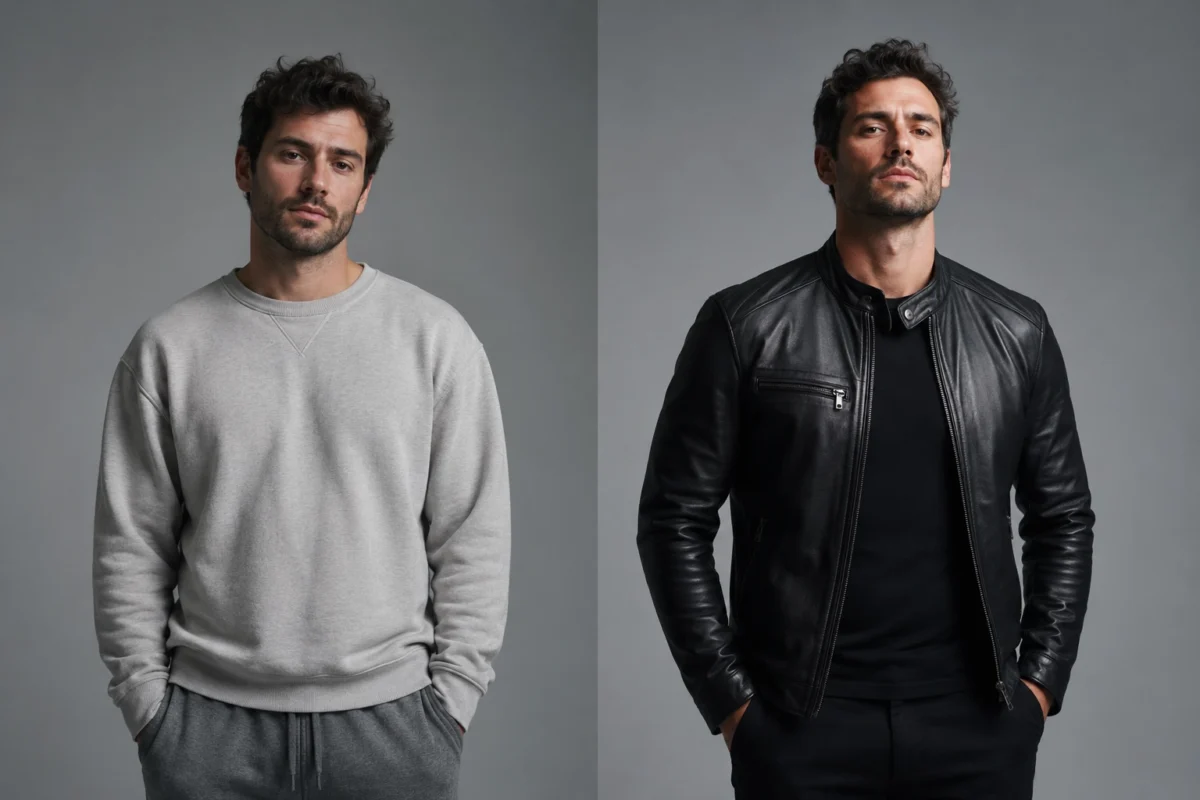
What Black Really Says Before You Speak
Color does not whisper. It states.
Black is one of the most loaded colors in the human visual vocabulary, and the loading runs in two directions at once. In professional settings, it consistently reads as serious, controlled, and credible – it is why judges, luxury labels, and the C-suite default to it the moment they want to be taken without argument. A recent breakdown of how color shapes perceived authority in professional dress lays out exactly why black still outperforms almost every other neutral when the goal is to be read as competent on sight.
But black carries a second, rougher edge. In sports research, teams that switch to black uniforms have historically seen penalty calls climb – not because the players changed, but because referees and opponents start reading the color itself as more aggressive. Same garment, same person, different read depending entirely on the room.
That ambiguity is not a flaw. It is the entire point.
Black does not have one fixed meaning – it amplifies whatever context it is dropped into. Wear it somewhere already tense and it can read as threatening. Wear it somewhere you are meant to lead and it reads as decisive, composed, faintly untouchable. Yes – that is exactly why you reach for black when you do not feel like explaining yourself. The color is not making the decision for you. You are. It works more like a volume knob than a switch, and the people who dress well with it have learned how far to turn it for a given room.

Leather as Modern Armor: Symbolism and History
Leather did not start as a fashion statement. It started as protection.
WWI and WWII aviators wore it to survive freezing open cockpits. Motorcyclists wore it because asphalt does not negotiate. Long before anyone called it “edgy,” leather was simply the material you trusted with your own skin.
Then the meaning shifted. Through the middle of the twentieth century, the leather jacket moved out of military kit bags and into the wardrobes of greasers, bikers, and eventually punk and rock subcultures – worn by people who wanted visible distance between themselves and the mainstream. Marlon Brando, James Dean, the Ramones a generation later: none of them were dressing for comfort. They were dressing for distance, between vulnerability and armor.
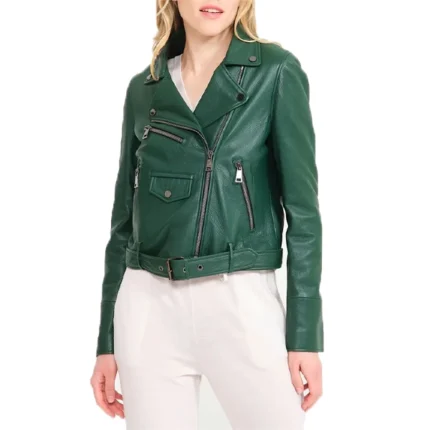
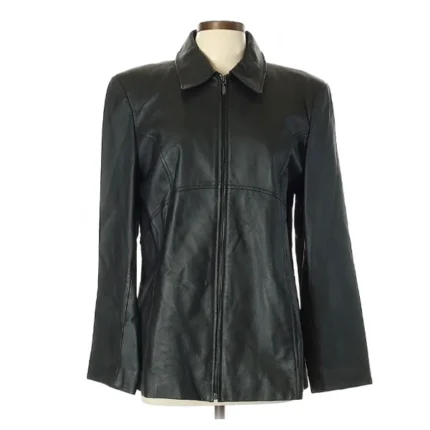
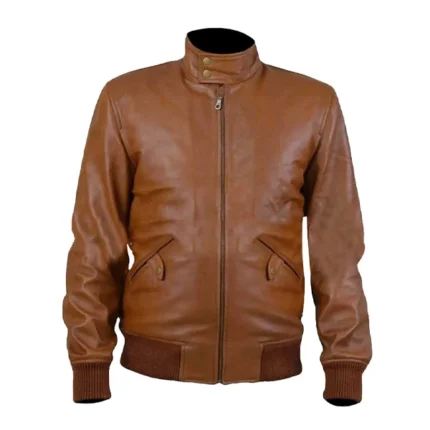
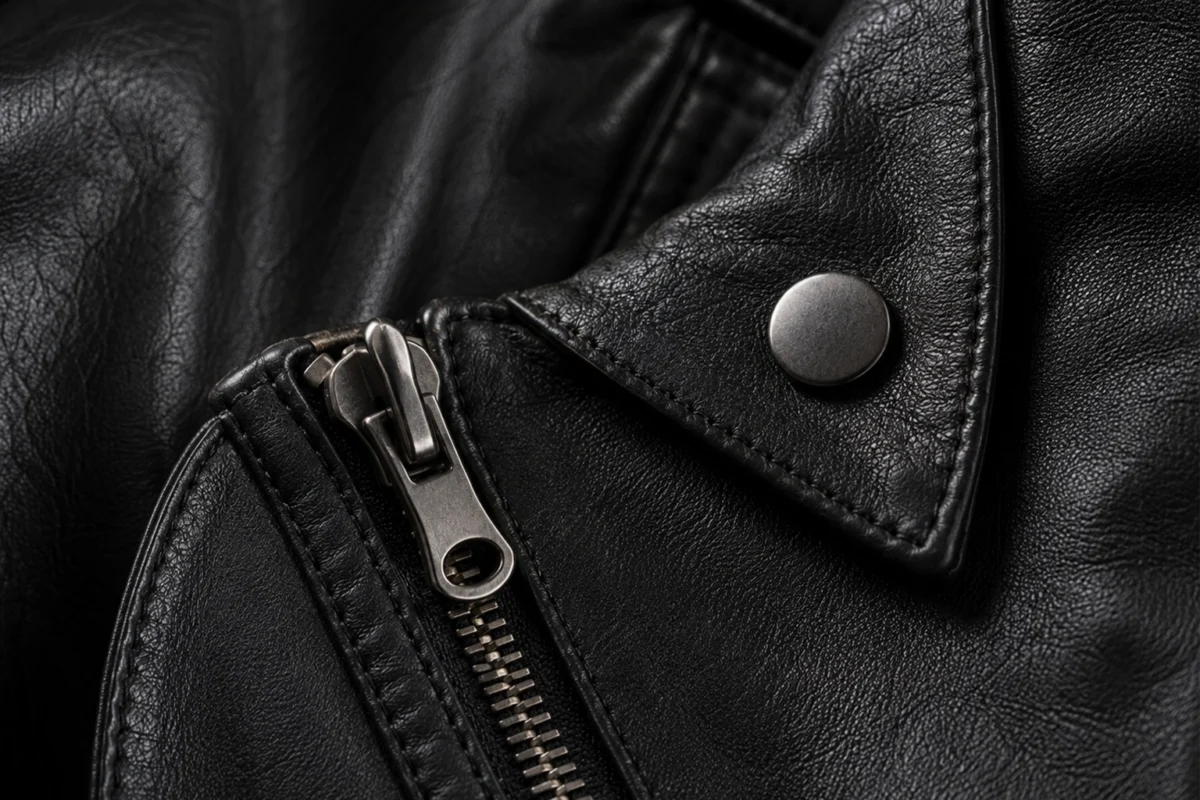
That history does not evaporate because you are wearing the jacket into a client meeting instead of onto a motorcycle. It rides along underneath. Whether you gravitate toward the structured precision of a biker cut or the cleaner lines of a café racer, the silhouette still carries a slightly different version of that same inherited story – Jacketstown’s breakdown of the different types of leather jackets is worth a look if you want to see how each cut reads before you have said a word. Black leather sharpens all of it further: strength plus mystery, hardware and patina standing in for a résumé you have not had time to recite.
Put it on, and you are borrowing a long, mildly rebellious cultural memory – pilots, rebels, rock stars, and the handful of executives who would rather not dress like everyone else in the room. The Leather Jacket itself has carried that dual identity, protective gear and rebellious symbol, for almost a century now, which is exactly why it still reads as more than just outerwear.
Enclothed Cognition: When Clothes Change Your Mindset
Here is the part that sounds like a stretch until you read the research behind it.
In the original enclothed cognition studies, people performing attention tasks while wearing a white coat they believed belonged to a doctor outperformed people wearing the exact same coat after being told it belonged to a painter. Same fabric, same body, different result – because the meaning attached to the garment changed how the brain engaged with the task.
For years, psychologists argued over how much of that early finding was real versus overstated. Then came the cleanup work. A 2025 meta-analysis revisiting decades of clothing-and-cognition research found that while some of the flashiest early results did not fully hold up under closer scrutiny, the core effect survived the audit. Clothing tied to specific psychological meaning measurably shifts focus, persistence, and self-reported confidence, with the strongest evidence coming from studies published after 2015, once methods in the field had tightened up.
Translate that to a black leather jacket. If you personally associate it with strength, independence, or “the version of me that does not flinch,” putting it on can genuinely nudge you toward that state, not as wishful thinking but as a documented psychological lever. The effect is not magic and it is not universal – it depends on the meaning you have personally attached to the garment, not on some property baked into the leather itself.
This is the part most people skip past: the jacket has to feel like an upgrade, not a costume. If black leather feels like someone else’s idea of cool, it will not do much for you. If it feels like the sharpest available version of something already true about you, the effect compounds every time you wear it.
How Others Read You: Person Perception and Power Dressing
While you are feeling the internal shift, the room is doing its own math at the same time.
Person-perception research treats clothing as a genuine input into how quickly people form judgments about competence, status, and intent – alongside face, posture, and tone of voice, not separate from them. People decide what you probably are, roughly, before you have finished a sentence. Clothing does a significant share of that early, silent talking, and recent person-perception research increasingly treats dress as a core input rather than a footnote to it.
Black clothing tends to push two needles at once: perceived authority and seriousness rise, and so, depending on setting, does perceived aggression or distance. A black leather jacket on someone standing alone in a dim hallway reads very differently than the same jacket on someone behind a podium, mid-laugh, gesturing while they talk. Context edits the message constantly and without asking permission. Worth saying plainly: race, gender, and body type all shape how that signal actually lands on a given observer, and pretending otherwise does nobody any favors. Self-awareness about the room you are walking into matters more than the jacket itself ever will.
“Power dressing” in 2026 is not shoulder pads and a closed fist anymore. It is choosing pieces that support the specific role you are trying to occupy for that hour – negotiator, calm expert, creative lead, the person in the room who is clearly not nervous. A well-cut black leather jacket can do that work, provided it is styled with intention rather than thrown on like a costume: structured rather than chaotic, paired with grounded, unfussy basics underneath it.

Why Power Dressers Love Black Leather Specifically
Stack all three pieces together and the appeal stops being mysterious.
Black brings authority laced with mystery. Leather brings strength, resilience, and a faint, deliberate whiff of rebellion. Enclothed cognition supplies the inner click, the part where the jacket is not just seen, it is felt. Put those three together and you get a garment that says something most power dressing cannot: I am serious, I am independent, and I am not fully in uniform.
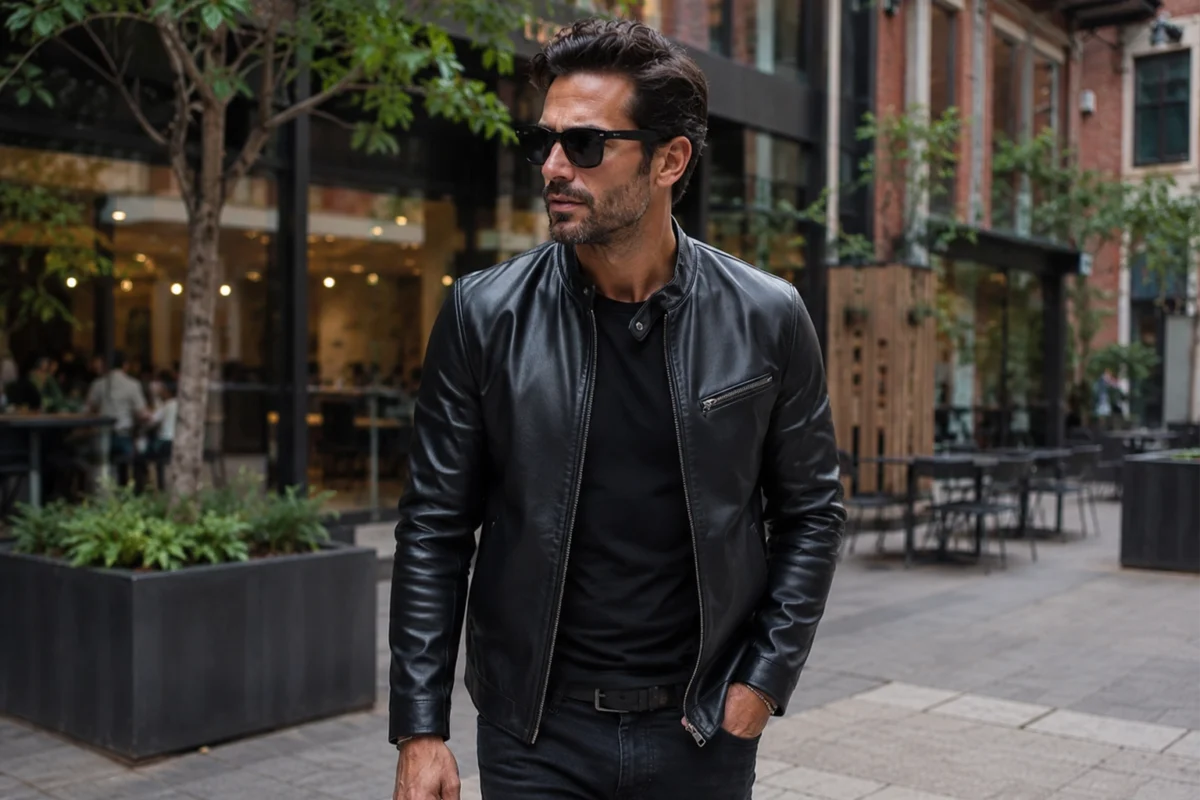
That is exactly why it shows up on people who could easily dress far more conservatively and choose, deliberately, not to. A creative director in a structured biker jacket and black jeans, walking into a pitch meeting full of navy suits and saying more with the jacket than the deck. A founder layering black leather over a plain tee and tailored trousers because a hoodie reads too casual for the room and a blazer reads too borrowed for who they actually are.
None of these people are cosplaying power. They are using a tool most wardrobes overlook: a piece of clothing that bridges formal authority and personal identity instead of forcing a choice between the two. A CEO in black leather over a crisp shirt reads differently than one in a navy suit, but no less in control, sometimes more so, because the choice signals confidence in their own read of the room. This is the lane that earns the most repeat attention: not the loudest jacket on the rack, but the one that visibly looks chosen on purpose.
Confidence in Practice: Before/After Moments and Micro-Rituals
Most confidence work stays invisible until you build a small, repeatable ritual around it.
Before: the familiar static. Fidgeting with a phone you are not actually reading. The mental loop running underneath everything else – what if I am not enough for this room today. Then the jacket goes on, and something measurable shifts almost immediately. Shoulders settle back. Breathing slows by half a beat. There is a sense of stepping into a slightly elevated version of a role that is still recognizably you, not a stranger wearing your face for the afternoon.
A few small rituals make that shift more reliable instead of accidental:
- Keep the jacket visible, never buried at the back of the closet. Seeing it before a hard task primes the association before you have even touched the leather.
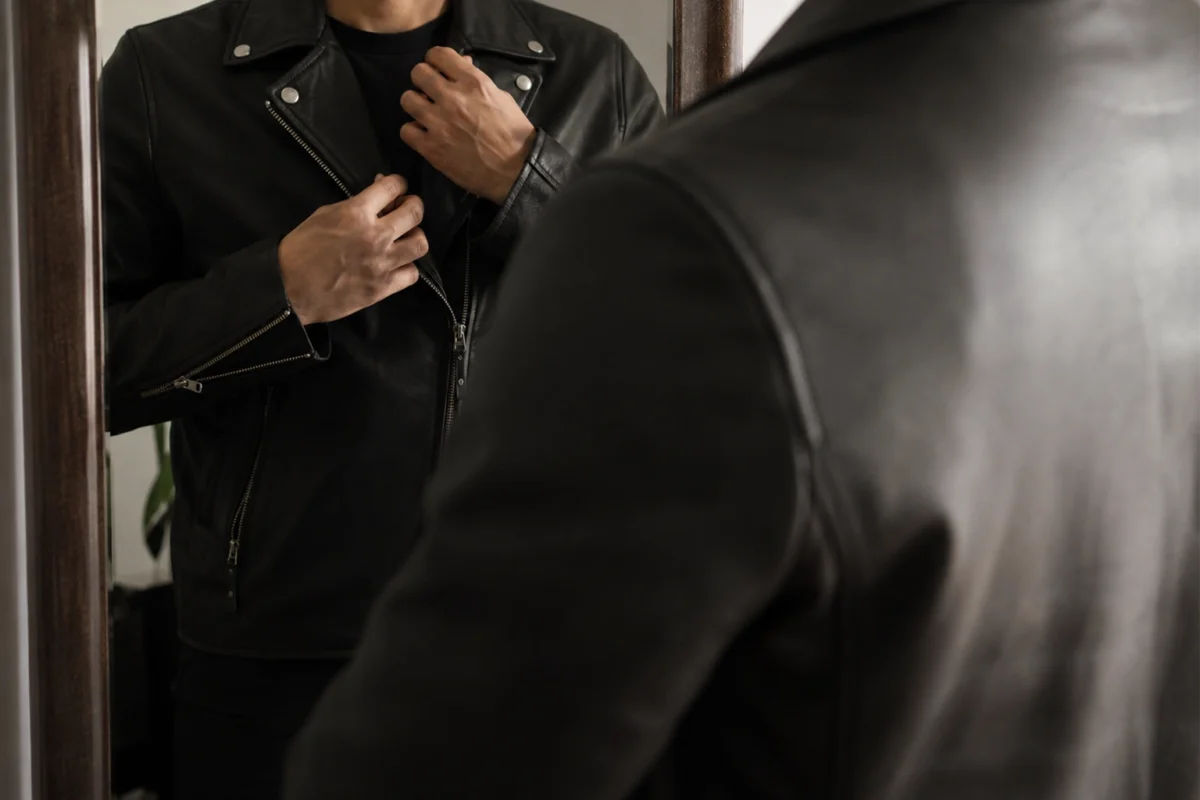
- Take thirty seconds, just thirty, standing in front of a mirror to breathe and adjust the collar before walking into a room that genuinely matters. That small pause does more work than people expect; it is the difference between throwing the jacket on and actually arriving in it.
- Pair the jacket with one grounding object you already associate with competence – a watch, a particular ring, a notebook you only bring to important meetings. Repetition builds the mental link faster than the jacket can build it alone.
- Getting the fit right matters here more than almost anywhere else in a wardrobe. A black leather jacket that is even slightly off through the shoulders reads as borrowed rather than owned, and it undercuts the entire effect before you have said a word. Jacketstown’s leather jacket size guide is a quick way to check yours before a big day.
None of this manufactures a skill that was not already there. The jacket does not write your pitch or land your argument for you. What it does is lower the static between you and the version of yourself that already knows how to do the thing in front of you, which, on most difficult days, is most of the actual battle.
How to Use a Black Leather Jacket in Different Power Contexts
The psychology only matters once you can apply it on a real Tuesday. A few scenarios worth trying on purpose:
High-stakes meeting or presentation. Black leather jacket, a clean shirt or fine-gauge knit underneath, tailored trousers or dark jeans, solid shoes. Let the jacket’s structure and the color’s built-in authority do the heavy lifting, and keep everything else minimal so the outfit reads as intentional rather than costumed. If you have never styled one for work before, a quick guide on how to style a black leather jacket is the fastest way to get the proportions right.
Difficult conversations or boundary-setting. This one is not about impressing anyone in the room. Wear the jacket over an outfit you already trust, and let it function the way it was designed to – as armor, not performance.
Networking and industry events. In creative fields especially, the jacket can quietly work as a conversation starter, a signal of individuality that does not require saying a word about it.
Everyday micro-power moments. Wear it to finally ask for the feedback you have been avoiding, walk into the unfamiliar class alone, or have the conversation you have postponed three times already. Notice what shifts when the choice is made on purpose instead of out of habit.
The experiment is the point. Pay attention to what changes when you choose the jacket deliberately versus reaching for it automatically – that difference is the whole mechanism, briefly made visible.
Caveats and Healthy Boundaries: When Power Dressing Backfires
Credibility means saying the uncomfortable part out loud too, not just the flattering half.
Black leather and power dressing do not erase structural bias, and they do not replace actual skill or preparation. A jacket can change how a room reads you in the first four seconds of contact. It cannot close a deal on its own, defuse a genuine conflict, or substitute for work you have not done yet. Treating it like a magic cape is exactly where people get into trouble – leaning on the armor to avoid the inner work instead of using it to support work already in progress.
There is also a real ceiling on intensity, worth respecting. If black consistently feels too sharp or simply not like you in certain settings, that is useful information about fit, not a personal failure. Charcoal, deep espresso brown, or a softer leather finish can carry most of the same psychological weight without quite as hard an edge – Jacketstown’s guide to other leather jacket colors is a solid starting point if black is not quite landing the way you want it to.
Use the jacket as a tool, full stop. Not a mask, not a personality replacement, and not a daily requirement. The goal is reliable access to your own steadiness on the days you need it most, not a permanent costume you are no longer able to take off.
FAQs
Does wearing a black leather jacket really make you more confident, or is it just placebo?
Some of both. Enclothed cognition research shows the effect is real but depends heavily on what the garment means to you. If you associate black leather with strength or competence, the boost is measurable, not pure imagination – but not detached from your own beliefs either.
Is black always the best color for power dressing?
No. It wins on authority and seriousness in most research, but it can read as cold or aggressive in the wrong setting. Navy feels more approachable, grey reads as quietly confident. Black is the highest-impact option, which also makes it the easiest one to overuse.
Can black leather jackets look professional, or are they always casual?
Cut and quality decide that, not the material. A structured, well-fitted black leather jacket over a crisp shirt and tailored trousers reads as intentional. A boxy, heavily distressed one over a graphic tee reads exactly as casual as it looks.
What if I feel “too much” in a black leather jacket?
Dial the intensity down rather than abandoning the idea. Softer knits underneath, a gentler leather finish, or switching to brown can preserve most of the benefit while turning the volume down a few notches.
Is there a difference in how men and women are perceived in black leather jackets?
Yes. Gender and context both shape whether the read lands as authority, edge, or attractiveness. Experiment in lower-stakes settings first, paying attention to how different rooms respond before wearing it somewhere that genuinely matters.
Do I have to wear all black for the effect to work, or is the jacket alone enough?
The jacket alone carries most of the weight. Mixing it with other colors underneath, a white shirt, olive trousers, a muted accent, keeps the look wearable while the jacket stays the focal piece.
How often should I actually use power dressing like this?
Save it for moments that genuinely matter. Used constantly, even the sharpest tool turns into background noise. Used selectively, it stays a switch you can flip on purpose.
The closet test from the start of this piece never really goes away. There is always another version of it waiting somewhere down the line, some morning before something that genuinely matters. What changes, once you understand what is happening when you reach for black leather, is the intention behind the choice itself. You are not simply grabbing a jacket off a hook. You are deciding which version of yourself walks into the room first. If you are ready to test that on your own terms, explore the black leather jackets collection at Jacketstown and choose the cut that feels less like a costume and more like the sharpest available version of you.