Blog
Sheepskin vs. Cowhide vs. Buffalo: The Ultimate Leather Guide
- The Anatomy of a Hide: Pores, Density, and Thickness
- Sheepskin Deep Dive: The Luxury Lightweight
- Cowhide Deep Dive: The Invincible Standard
- Buffalo and Bison Deep Dive: The Heavyweight Champion
- The Tanning Variable: Chrome vs. Vegetable Tan
- The Lifestyle Matrix: Head-to-Head Scenarios
- Aging and Patina: What Each Hide Looks Like in 10 Years
- Care and Conditioning: How to Maintain Each Hide
- FAQs
Which leather is best for a jacket: sheepskin, cowhide, or buffalo?
None is best. Each one is right for a different life. Sheepskin is the lightest and softest, and as shearling it is the warmest, but it tears and stains more easily. Cowhide is the durable standard, with tight fibers, real tensile strength, and a stiff break-in that rewards patience. Buffalo is the heavyweight, with a pronounced pebble grain, very high abrasion resistance, and surprising breathability for its thickness. Pick the hide that fits your climate, your commute, and how hard you’ll actually wear the jacket.
Most people buy a leather jacket from a product photo, and at $300 to $1,000 it’s a decision that can last a decade. The photo shows color and cut. It says nothing about fiber density, weight, or how the hide behaves after its third winter.
The category is big and still growing: the global leather jacket market is projected to reach nearly $43 billion by the end of 2026. More choice also means more confusion about materials. Before you compare hides, make sure the jacket is genuine leather in the first place. This real vs. faux leather breakdown covers that. Everything below assumes genuine hide.
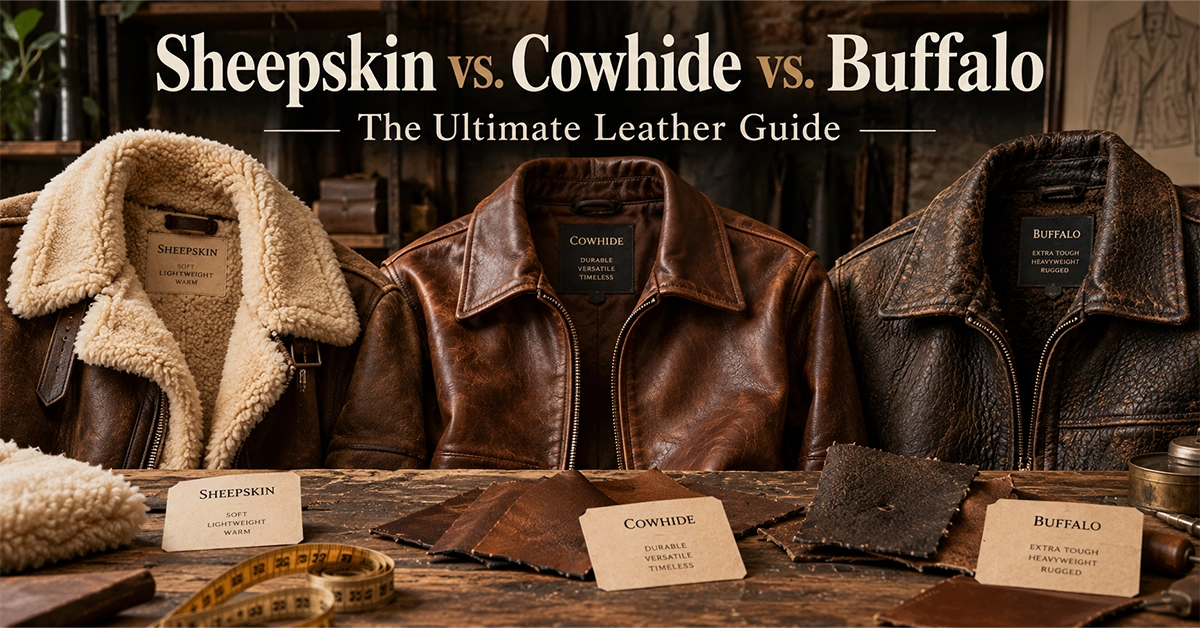
Three hides dominate serious outerwear: sheepskin, cowhide, and buffalo. No leather wins every category. There’s only the right leather for a specific climate and a specific life. Here’s the quick comparison, then the science behind it.
| Property | Sheepskin | Cowhide | Buffalo |
|---|---|---|---|
| Typical jacket weight | About 2 lb (lambskin), heavier as shearling | Roughly 3 to 5 lb | Often heavier than cowhide |
| Fiber structure | Fine, loose, high natural fat | Dense, tightly interlocked | Thick, open, wide follicles |
| Break-in | Almost none | Long and stiff | Moderate, then deep softening |
| Abrasion resistance | Low | High | Very high |
| Water tolerance | Poor, especially suede and shearling | Good when finished | Good, but porous, so it dries unevenly |
| Ages into | Buttery, thins at elbows | High-contrast creases | Multi-tonal patina in the grain |
| Best for | Mild or dry-cold climates, layering | Daily wear, riding, longevity | Heavy use, riding, rugged looks |
The Anatomy of a Hide: Pores, Density, and Thickness
Epidermis, Grain, and Corium
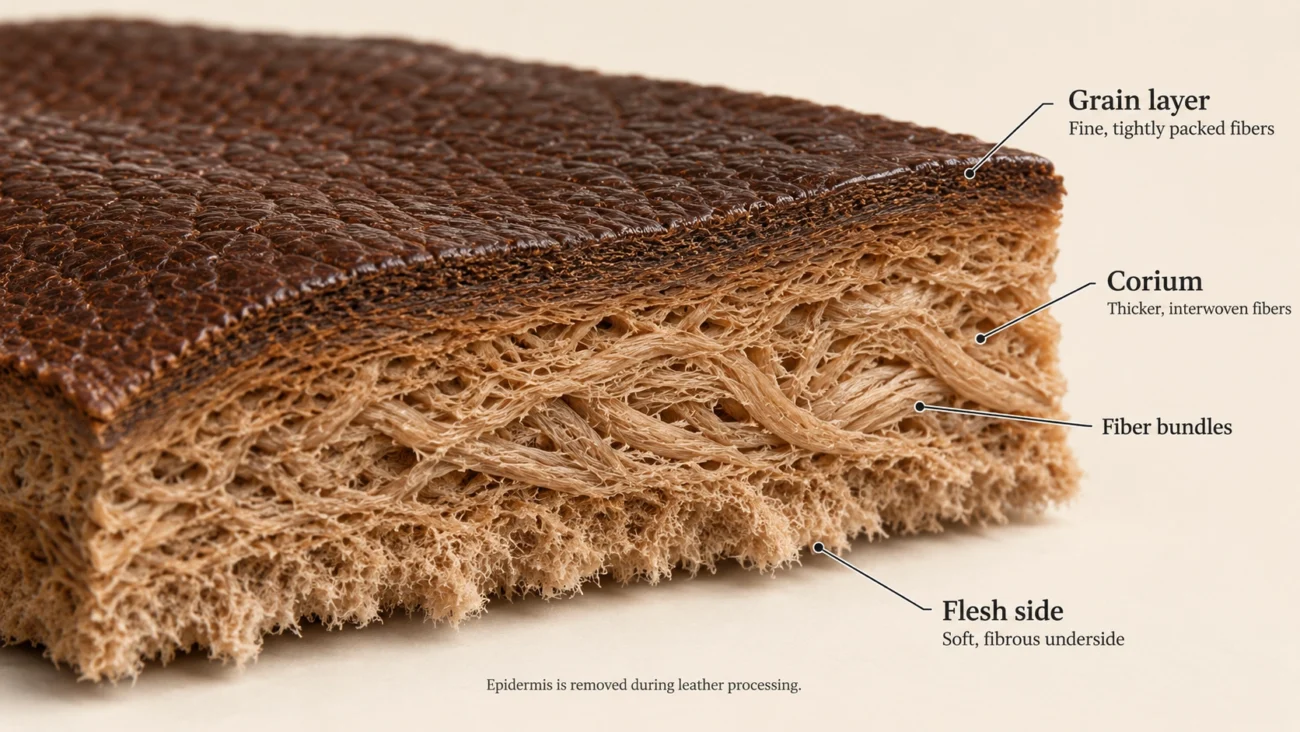
Start with what leather actually is. A raw hide has an outer epidermis, a dermis beneath it, and a layer of fat and flesh under that. The epidermis, the thin outer skin that carries the hair, never reaches your jacket. It gets stripped away in the beamhouse during liming and unhairing. What’s left to be tanned is the dermis, which divides into two working zones. The upper zone is the grain layer, made of fine, tightly packed collagen fibers and dotted with the pores where hair follicles once sat. The lower zone is the corium. It’s thicker and coarser, built from heavy fiber bundles that carry most of the mechanical load.
This matters when you’re shopping. Full-grain leather keeps the intact grain layer and the strength that comes with it. Top-grain is lightly sanded on the surface. Corrected-grain is sanded away and replaced with an embossed finish. Splits are the corium alone, sliced from the underside. This guide covers full-grain and top-grain only, because a split-based jacket is a much shorter story.
Why Fiber Density Decides Everything
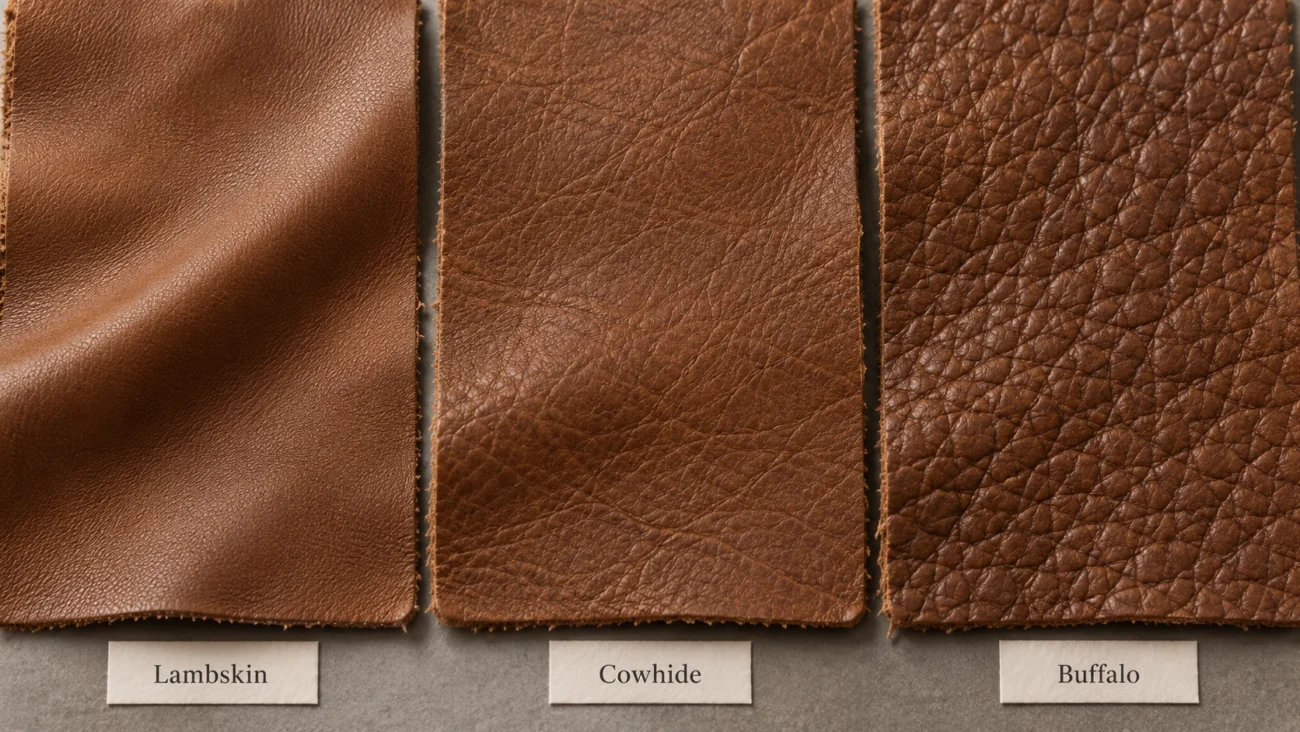
Under a microscope, a hide looks like a woven mat of collagen. Cattle hide packs thick fiber bundles at steep, interlocking angles, creating a three-dimensional felt that resists being pulled apart in any direction. That interlock is why a cowhide strap survives a motorcycle and a lambskin strap doesn’t.
Sheepskin is built the opposite way. Its fibers are finer, looser, and lie flatter, and the hide carries an unusually high amount of fat between the grain and the corium. That fat is what makes sheepskin soft. It’s also a structural weak point. Under stress the grain can separate, and once a snag starts a tear, the loose weave lets it keep running. That damage can’t be undone.
Buffalo sits in a third position. The hide is thick, with large, open fiber bundles and visibly wider follicle openings. That open structure gives buffalo mass without tightness, which is why it’s heavy, tough, and oddly breathable all at once.
How Thickness Translates to Weight
Thickness is measured in millimeters or ounces, and it predicts feel better than any marketing label. As a rough guide, jacket-weight lambskin usually runs about 0.6 to 0.9 mm. Cowhide for a jacket typically lands between 1.0 and 1.4 mm. Buffalo starts around 1.2 mm and climbs past 1.5 mm on motorcycle-weight pieces. These ranges overlap and vary by tannery, so treat them as a guide, not a spec. Weight follows thickness: a lined lambskin jacket weighs about 2 pounds, cowhide runs roughly 3 to 5 pounds, and a heavy buffalo moto jacket can weigh more than that. Carry one around for a full day and the numbers stop being abstract.
Sheepskin Deep Dive: The Luxury Lightweight
Lambskin vs. Mature Sheepskin
Lambskin comes from lambs, typically under a year old. The fibers are fine, the grain is tight for a sheep product, and the hand is the softest you can buy at jacket weight. Mature sheepskin, from older animals, is thicker, coarser, and sturdier. Most shearling is made from it, because the wool needs a hide strong enough to anchor it. In my experience working with raw hides, buyers tend to hear “sheepskin” as the practical word and “lambskin” as the luxury one. The real difference is age, thickness, and what the hide is being asked to do.
Wool-On, Shearling, and Unlined
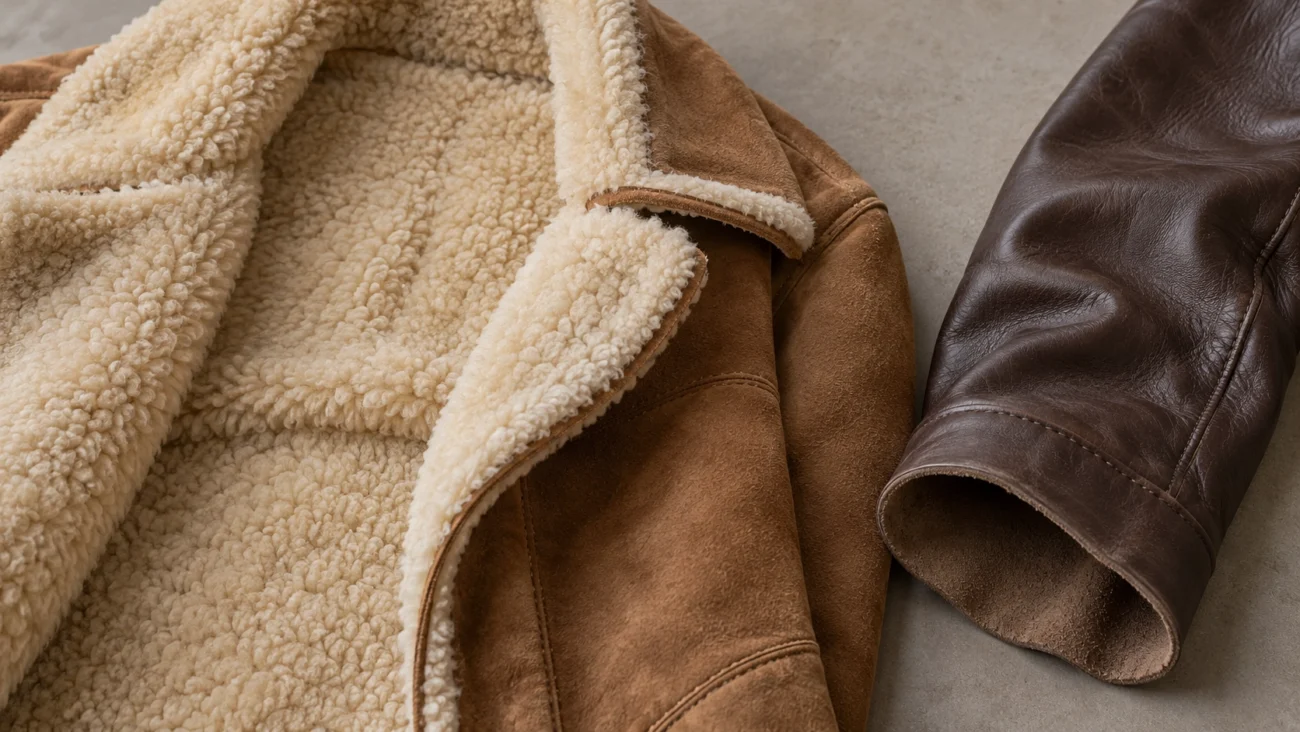
Three constructions share one animal. Unlined napa or suede lambskin is a single layer of hide. It’s light, fluid, and uninsulated apart from trapped air. Shearling is sheepskin tanned with the wool intact and trimmed short, suede on the outside and wool on the inside. Wool-on uses a longer fleece, so it looks shaggier. The warmth comes down to physics: wool fibers have a natural crimp that traps air, and that trapped air is the insulation. A shearling jacket’s warmth belongs to the wool. The leather is just the carrier.
Drape and the Break-In That Barely Exists
The first wear feels like the hundredth. That’s the appeal, and it’s also the trade-off. Because the hide starts soft, it never goes through a stiff phase that molds it to your body. It conforms by stretching instead. Over the years, shoulders and elbows creep outward. That doesn’t mean something is wrong with the jacket. It’s just how a loose-fibered hide records wear.
Water, Abrasion, and the Hanger Problem
Water is sheepskin’s worst enemy. A rainstorm on suede-finished lambskin leaves dark spots and stiffens the hide as it dries. On shearling, it mats the wool and hardens the suede side. Abrasion comes second: sheepskin scuffs, pills, and burnishes quickly against bag straps and car seats. Then there’s the hanger. The same natural oils that keep the hide supple also let it stretch, so a thin wire hanger can drag the shoulders into permanent peaks within a season. Use a wide, contoured hanger, or store the jacket folded.
Who Sheepskin Fits
Sheepskin suits drivers, office wearers, layering fans, and anyone in a dry, cold climate who cares about warmth per pound. It’s a poor match for rainy commutes or backpack-and-turnstile days. The shearling design also has real heritage. The comparison of horsehide and shearling flight gear in the A-2 vs. B-3 aviator jackets guide shows what the wool-on design was originally built to survive, and aviator-style jackets are still its clearest modern descendants.
Cowhide Deep Dive: The Invincible Standard
The Physics of Tensile Strength
Cowhide gets its strength from geometry. Dense collagen bundles cross at interlocking angles, so force applied in one direction is shared across fibers running in many directions. A stitched seam in cowhide usually fails at the thread before the hide tears. In sheepskin, it’s often the other way around. For anyone who rides, hauls gear, or simply refuses to baby a jacket, that margin is the whole reason to buy cowhide.
What Actually Happens During Break-In
Break-in is uncomfortable, and it’s better to hear that up front. A new cowhide jacket feels stiff because tight fibers, a protective finish, and tannery conditioning all resist movement. Every bend at the elbow and shoulder flexes those fibers. Body heat and skin moisture slowly soften the hide, the fibers realign along the lines you move on, and creases set where you bend. That takes weeks of wear, sometimes months. Many buyers give up during this phase and call the jacket defective, but nothing is wrong with it. This guide to softening a stiff leather jacket explains how to speed things up without damaging the finish.
Steerhide vs. Standard Cowhide
“Cowhide” is a broad term. Steerhide comes from castrated male cattle, and the hide tends to be thicker, more uniform, and cleaner in grain. Hides from dairy cows or bulls can show stretch marks, scarring, or uneven thickness. Neither is automatically better, but steerhide is the usual choice when a maker wants a heavy, even, durable jacket. A standard cowhide jacket weighs roughly 3 to 5 pounds, so feel the weight on the hanger before you decide how mild a day you can wear it on.
Who Cowhide Fits
Cowhide fits the everyday wearer who wants one jacket to outlast three. It also suits structured designs that need the hide to hold its shape, like armor-style paneling, padded shoulders, and moto cuts. That’s why armor-style character designs, including Batman-inspired jackets, usually call for a heavier, firmer hide. A soft lambskin would slump under the same paneling. When you’re unsure, cowhide is the safest choice.
Buffalo and Bison Deep Dive: The Heavyweight Champion
Buffalo vs. Bison: A Quick Clarification
On jackets, “buffalo leather” usually means water buffalo hide, a staple of South Asian tanneries. American bison is a different animal with a different, rarer hide. The two share traits that matter here: a thick dermis, an open fiber structure, and a distinctive surface. If a listing says buffalo, ask which one. The answer changes what you should expect on softness and price.
Pebble Grain and Breathability
The first thing you notice on buffalo leather is the grain. It’s deeply pronounced, irregular, and usually left unsanded, which gives the surface a natural pebble that cowhide rarely matches without embossing. Underneath, the follicle openings run wider and the fiber weave is less tightly locked than in cattle hide. The result is counterintuitive: buffalo is thicker than cowhide but breathes slightly better, because air and moisture move through it more easily. On a moderately warm day, a buffalo jacket can feel less clammy than a thinner, tighter cowhide one.
Weight Class and Abrasion Resistance
At comparable cuts, buffalo is the heaviest of the three, and that mass buys real abrasion resistance. Thick, open fiber bundles take scraping punishment without surface damage better than thinner hides do. The price is carrying weight. A buyer who expected a light spring jacket will complain within the hour. I’ve watched it happen.
Why Buffalo Ages Differently
Cowhide shows wear on the surface and at the creases. Buffalo tends to age deeper. Oils and pigments settle into the pebble valleys while the raised ridges burnish, which creates a multi-tonal look that seems hand-finished rather than faded. Because the grain is deeper, a scratch is less likely to read as a scar and instead blends into the texture. That’s a different aging logic from the sharp contrast of cowhide, and it’s why some buyers choose buffalo purely for how it will look in year eight.
Who Buffalo Fits
Buffalo fits heavy-use wearers, riders, and anyone who wants a rugged, textured look and doesn’t mind the weight. It’s a poor choice for a fashion piece in a warm city. Buy a heavy buffalo hide as a style layer in Los Angeles and you’ll feel the mistake on the first mild afternoon.
The Tanning Variable: Chrome vs. Vegetable Tan
Tanning turns perishable raw hide into stable leather, and the method changes the same hide more than most buyers realize. The industry is big, too: one research estimate values the global leather tanning market at roughly $29 billion in 2026. Two main methods dominate it, for very different reasons.
Chrome Tanning
Chrome tanning uses chromium salts, mainly chromium sulfate, and finishes a hide in days instead of weeks. The leather comes out soft, even in color, more heat-tolerant, and more resistant to water spotting. Nearly all lambskin jackets are chrome-tanned or tanned with a close alternative, because the process gives the supple, consistent feel buyers expect. The trade-off is that it doesn’t develop the dramatic patina of vegetable-tanned leather. Wear shows up as scuffs and creases instead.
Vegetable Tanning
Vegetable tanning uses plant tannins from bark and other sources, and the traditional process takes weeks to months. The leather is firmer, denser, and has a rich natural smell. It darkens and glows with oil, sun, and handling, but it also water-stains easily. This is the tan behind the 20-year story: raw, light, and stiff at purchase, then deep and personal a decade later. It’s much rarer in finished jackets and costs more, because time is the main ingredient.
How Tanning Changes Each Hide
Sheepskin is almost always chrome-based, because chrome gives its loose, fatty fibers the softness buyers want. Cowhide comes in both, and the tanning method is the biggest single factor in how it ages. Buffalo takes either. A vegetable-tanned buffalo jacket is the heaviest, stiffest, slowest-aging option in this guide, and it’s a serious commitment for someone who knows exactly what they want. Ask the maker which tan was used. A tag that only says “genuine leather” doesn’t answer that.
The Lifestyle Matrix: Head-to-Head Scenarios
| Scenario | Best Fit | Why |
|---|---|---|
| Daily commuter | Cowhide (transit) or lambskin (driving) | Straps, seats, and turnstiles punish soft hides; a car does not |
| Harsh winter resident | Shearling sheepskin; lined cowhide for wet snow | Warmth comes from wool or lining, not the leather itself |
| Fashion and layering | Lambskin or light cowhide | Drape and low bulk fit under an overcoat |
| Highway rider | Thick cowhide or buffalo | Abrasion resistance and wind protection; never sheepskin |
Scenario A: The Daily Commuter
Public transit is rough on leather. Seat edges, bag straps, and crowded doorways all rub, and rain shows up without warning. A cowhide jacket in a clean, simple cut can take that for years. If you drive, the math changes: lambskin’s softness and low weight make sense when nothing rubs against it. Cut matters as much as hide here, and this types of leather jackets overview helps match a silhouette to your routine.
Scenario B: The Harsh Winter Resident
Leather alone isn’t insulation. Warmth comes from wool, lining, and the air they trap. Dry, deep cold favors shearling sheepskin, which gives the most warmth per pound. Wet snow and slush favor a lined cowhide, which sheds moisture better and handles road salt. Buffalo is sturdy but heavy, and without a proper lining it’s no warmer than cowhide. For longer cuts, the coat category is where shearling and lined hides tend to show up.
Scenario C: The Fashion and Layering Enthusiast
Drape is the priority here, and bulk is the enemy. Lambskin wins. It slides under an overcoat, folds cleanly at the elbow, and hangs close to the torso. A lighter cowhide in a slim cut is the more durable option. Skip buffalo for this role, since its thickness fights layering and pushes the silhouette outward.
Scenario D: The Highway Rider
Wind pressure and abrasion define this use. Thick cowhide or buffalo is the right material, and sheepskin is not. One caveat: a fashion jacket isn’t certified protective gear. Leather thickness helps with abrasion, but impact protection comes from properly rated armor. If you ride seriously, look at biker jackets built for the purpose, and check the armor pockets and fit before anything else.
Aging and Patina: What Each Hide Looks Like in 10 Years
Sheepskin After a Decade
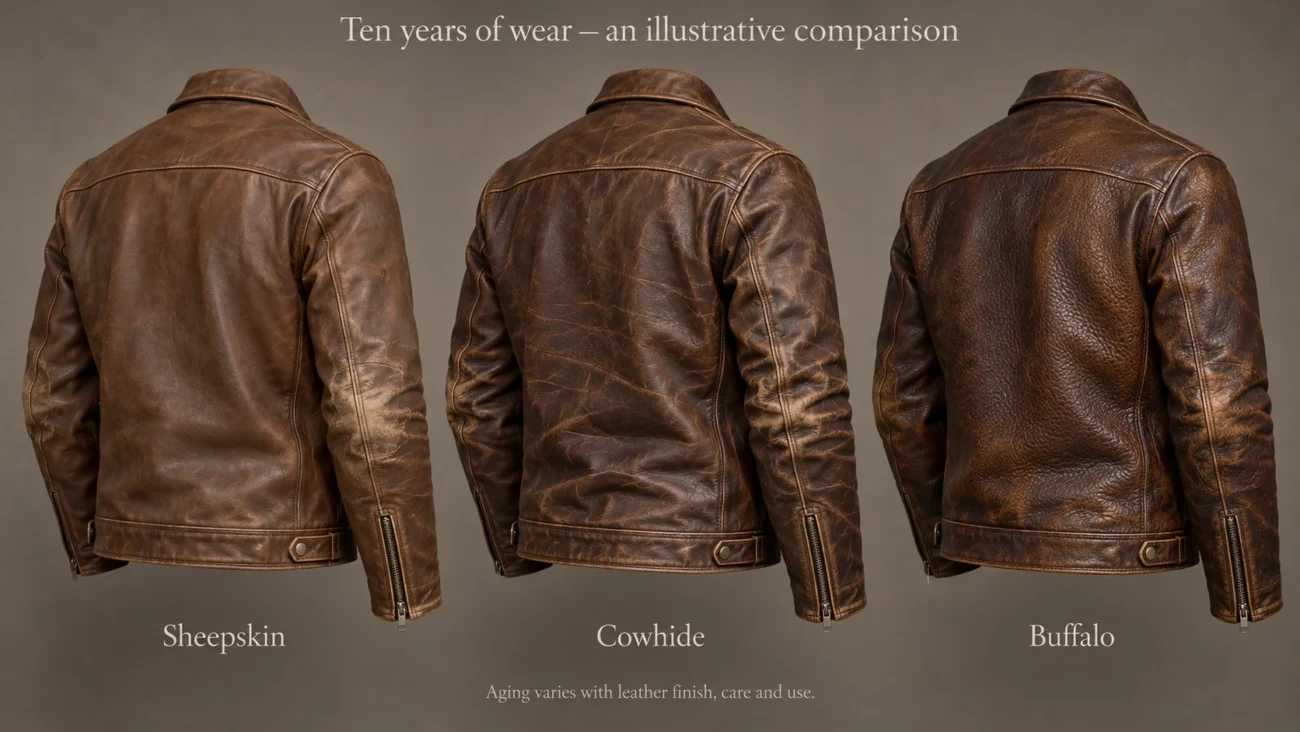
Sheepskin turns very soft and visibly thinner where friction concentrates. The elbows, cuffs, and lower hem wear first and sometimes show a lighter, worn surface. Without care, the grain can scuff to a dull, faded finish. With proper care and a good hanger, it can look soft and lived-in instead of tired. The structure, however, doesn’t recover once it has stretched.
Cowhide After a Decade
High-contrast creases form at the elbows, shoulders, and across the back where the jacket flexes. Color on raised surfaces burnishes lighter, while the creases hold darker pigment and oil. On vegetable-tanned jackets, the whole piece deepens and glows. On chrome-tanned ones, the change is subtler, more about scuffs and softness than color. Either way, it looks like the person who wore it.
Buffalo After a Decade
Buffalo develops a rich, multi-tonal patina deep in the pebble grain. The valleys go dark, the ridges polish up, and no two areas look quite alike. It won’t crack easily, and scratches fold into the texture. Warm tones like brown leather jackets show this aging most clearly, because the pigment shifts are easier to see against a mid-tone base.
What a Twenty-Year Lifespan Actually Takes
Material is only half of longevity. The other half is how you treat the jacket: a fit that doesn’t strain the seams, rotating it so it isn’t worn daily in every kind of weather, conditioning it on a schedule, and storing it dry on proper support. Spread over two decades, the higher purchase price looks different. This cost-per-wear breakdown of a 20-year leather jacket works through the numbers.
Care and Conditioning: How to Maintain Each Hide
Conditioning Sheepskin
Use less than you think you need. Heavy oils and waxes darken suede, mat shearling, and can leave soft napa greasy. Use a soft brush on suede and shearling, spot-treat with products made for the finish, and keep the jacket away from heat. If it gets wet, blot it, shape it, and let it dry slowly at room temperature. A radiator or hair dryer can shrink and harden the hide in a single afternoon.
Conditioning Cowhide
Cowhide handles routine care well. Apply a light conditioner once or twice a year in thin coats, then buff it off to replace the oils that body heat and weather pull out. Test any product on a hidden spot first. Over-conditioning is the more common mistake. It softens the hide past its structure and attracts dirt.
Conditioning Buffalo
Because of its open fiber structure, buffalo soaks up conditioner quickly. Apply it sparingly and work it into the pebble grain with a soft cloth. Thick coats pool in the valleys and darken unevenly. The hide is heavy, so give it proper support in storage, since a narrow hanger will slowly pull the shoulders out of shape.
Cleaning and Storage for All Three
Wipe surface dirt with a barely damp cloth, never soak the hide, and store the jacket in a breathable garment bag, not plastic. For a step-by-step routine, the guide on how to clean a leather jacket at home covers spot tests and the order of operations, which matters more than the product.
FAQs
Which leather is the most durable for a jacket?
Buffalo and thick cowhide lead for abrasion and sustained hard use, with buffalo holding a slight edge in surface toughness. Sheepskin is the least durable of the three, though it isn’t fragile when handled properly.
Is buffalo leather better than cowhide?
Not universally. Buffalo is heavier, more textured, and more breathable for its thickness. Cowhide is lighter, more widely available, and easier to find in refined cuts. Choose based on how much weight you’ll tolerate and the look you want.
Does sheepskin hold up in rain?
Poorly. Suede-finished lambskin and shearling stain and stiffen when soaked. Smooth napa lambskin is more forgiving, but none of it makes a good rainy-commute hide.
What is the difference between lambskin and sheepskin?
Age and thickness. Lambskin comes from young animals and is finer and softer. Sheepskin comes from older animals and is thicker and sturdier, which is why most shearling uses it.
How long should a good leather jacket last?
Fifteen to twenty years is realistic for cowhide or buffalo with proper care. Sheepskin usually has a shorter working life unless it’s stored and handled carefully.
Is chrome-tanned or vegetable-tanned leather better?
Neither is better in the abstract. Chrome-tanned leather is softer, more consistent, and more water-tolerant. Vegetable-tanned leather is firmer, more expensive, and develops a far richer patina over time.