Blog
A-2 vs B-3 Aviator Jackets and Which Design to Choose
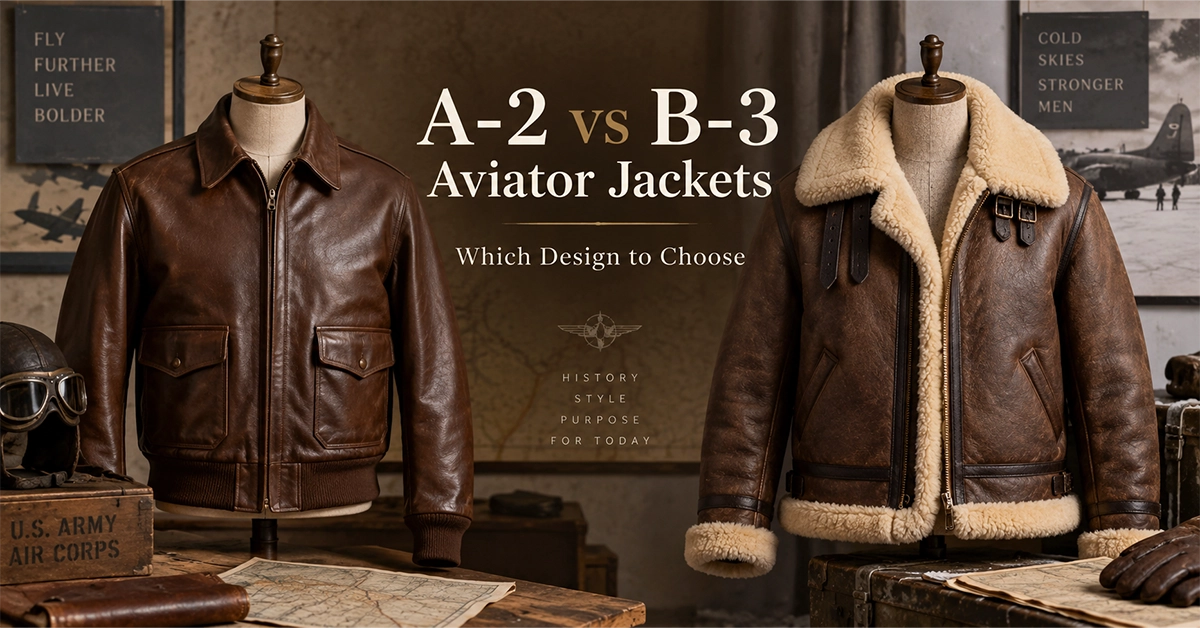
Quick Answer: The A-2 is a slim, waist-length leather flight jacket traditionally made from horsehide or goatskin, with a zip front and knitted cuffs and waistband. The B-3 is a much heavier sheepskin shearling jacket with a wide fur collar and buckle details, designed for significantly colder conditions. Choose the A-2 if you want a versatile aviator jacket that’s easy to wear in everyday outfits. Choose the B-3 if warmth is the priority and you need a substantial winter jacket for genuinely cold weather.
Two of the most copied leather silhouettes on earth came out of the same decade, for two completely different survival problems.
I’ve had both jackets across the workbench more times than I can count over twelve years of sourcing, restoring, and fitting military-inspired outerwear, and the thing that still catches people off guard is how differently they were engineered. One was cut close to the body on purpose. The other was cut loose on purpose. Neither is “better” in a vacuum – they were solving different problems in different airplanes.
Customers usually walk in already knowing they want “the pilot jacket” without knowing which pilot jacket they mean. Fair enough – from across a room, a well-worn A-2 and a well-worn B-3 both scream “aviator.” Up close, they’re almost opposites. One hugs the torso like a fitted shirt. The other wears like a sleeping bag with sleeves. That difference isn’t an accident of fashion. It’s a direct readout of the two missions these jackets were built to survive.
Set the scene: late 1920s into the 1940s, U.S. military aviation, open or semi-heated cockpits, and a very real physical cost to getting dressed wrong before a mission. Fighter pilots needed to move. Bomber crews needed to survive hours at altitude in unpressurized cabins. Jacketstown’s aviator jacket lineup still carries both silhouettes today, and demand hasn’t exactly cooled – the leather jacket category as a whole is tracking toward nearly $43 billion in global sales by the end of 2026, driven in large part by exactly this kind of heritage military design.
By the end of this, you’ll know why each jacket looks the way it does, and which one actually fits your life rather than your mood board.
The A-2: Built for Fighter Pilots, Not Bulk
The A-2 wasn’t dreamed up by a fashion house. It was standardized by the U.S. Army Air Corps under specification 94-3040, adopted on May 9, 1931, as the direct successor to the earlier button-front A-1. That’s not a marketing date. It’s a procurement date, and you can still find the paperwork – along with original jackets that survived the war, some still carrying the hand-painted nose art crews added to personalize an otherwise plain, government-issue garment.
Materials first. The A-2 was cut from seal-brown horsehide or goatskin, originally lined in spun silk before wartime supply pushed manufacturers toward rayon and cotton. Horsehide has a tighter grain than most cowhide – it feels almost waxy fresh off the hanger, a little stiff, a little reluctant. Wear it for a season and it breaks in like a baseball glove that finally remembers your hand. Goatskin runs slightly softer out of the gate, which is why you’ll see both leathers used across original wartime contracts and modern reproductions – dozens of manufacturers turned out A-2s under the same specification, and no two runs feel quite identical.
Construction is where the A-2 gets interesting. Zippered front. Shirt-style snap-down collar. Knit cuffs and a knit waistband to seal in warmth. Shoulder straps that read as epaulets. Snap-flap patch pockets – and here’s the detail most guides skip entirely: no hand-warmer pockets. Military designers reportedly wanted a pilot’s hands visible at all times, not jammed in his coat like he was freezing on a street corner. A one-piece leather back reduced seam stress across the shoulders, which matters a lot more than it sounds when you’re reaching for a control stick.
Mission fit: this jacket went to fighter pilots and lower-altitude crews flying semi-heated cockpits, where a trim, mobile silhouette mattered more than raw insulation. It sits in the same family as the rest of the wider world of leather jacket silhouettes built for a specific job rather than a general vibe. And if you’re weighing genuine horsehide against a synthetic look-alike before you buy, it’s worth reading through the real vs. faux leather breakdown first – the difference shows up in exactly the areas the A-2 depends on: the grain, the drape, the way it ages.
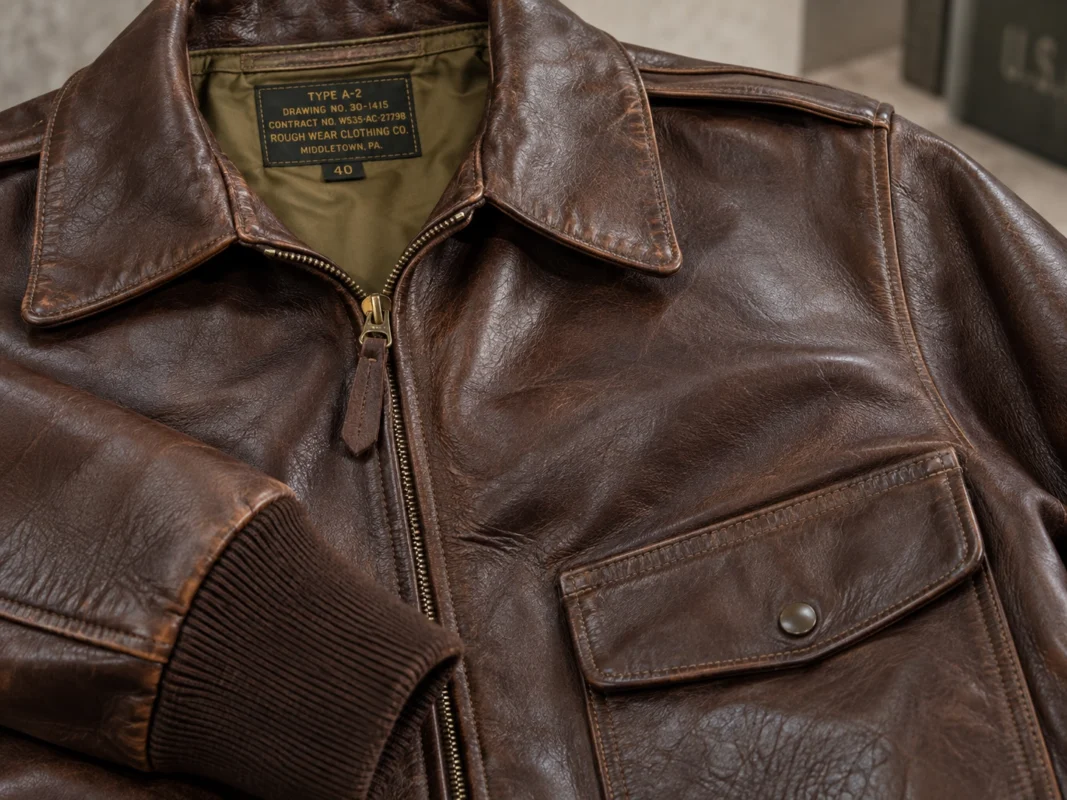
One myth needs killing here. The A-2 gets called a “bomber jacket” constantly, and it wasn’t. It was mostly issued to fighter pilots and ground-adjacent crews. Strap one on and fly a B-17 at 25,000 feet in it and you’d have been in genuine trouble – the jacket simply wasn’t built to hold heat at that altitude, and pretending otherwise is how people end up disappointed by a jacket that was never designed for their climate in the first place.
The B-3: Built for Bomber Crews at 25,000 Feet
The B-3 showed up in the mid-1930s – most records point to 1934 – as the answer to a much colder, much longer problem: keeping a bomber crew alive and functional through 8-to-9-hour missions over Europe, sitting in unpressurized, unheated fuselages. This wasn’t a jacket for the pilot alone. Gunners stationed in exposed turrets, often with a hatch open to the slipstream for hours at a time, needed something closer to survival gear than outerwear, and that’s exactly the problem sheepskin was drafted to solve.
Sheepskin, worn with the wool left on the inside, was the material that solved it. Nothing synthetic available at the time came close. Shearling traps air in the crimp of the wool fiber itself, which is why it insulates so differently from a lined jacket – the warmth isn’t a liner bolted onto a shell, it’s the hide doing both jobs at once. Run a hand across the inside of a good B-3 and you’ll feel the difference immediately against a horsehide A-2: dense, springy, almost alive under your fingers, versus the flat, cool lining of a stitched-in liner.
Construction diverges hard from the A-2 here. A wide fur collar, closed by two leather straps and buckles instead of a zipper – no knit waistband at all, which is part of why the B-3 reads bulkier the moment you put it on. This is a coat wearing a jacket’s name. Pilots and gunners sitting in exposed turrets for hours needed survival-grade warmth far more than they needed agility, and the B-3 delivers exactly that trade. It’s also the jacket General Patton famously wore in a modified form, which did the B-3’s reputation exactly zero harm.
Climb to a real bomber cruising altitude and the air itself explains the design choice. Standard atmospheric conditions put you well below freezing before you even hit 30,000 feet, with temperatures dropping toward -50°F once you’re up where a B-17 actually flew. That’s not a jacket problem you solve with a slimmer cut.
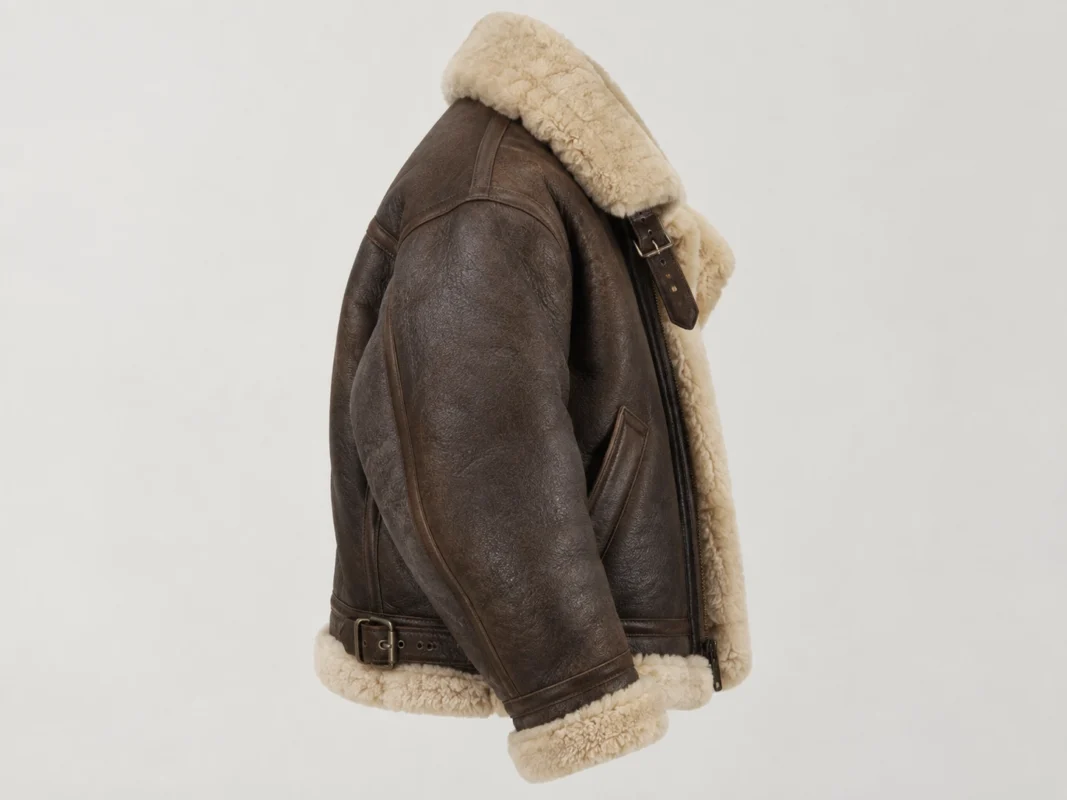
Here’s the blunt part most sales copy won’t say out loud: the B-3 is overkill for almost anyone’s daily life. Unless you’re commuting through genuinely brutal winters, you’ll overheat indoors, struggle to layer it under anything, and end up wearing a museum piece to the grocery store. Respect the design. Just be honest about whether your actual climate needs it.
Side-by-Side Construction Comparison
| Feature | A-2 | B-3 |
|---|---|---|
| Adopted | 1931, U.S. Army Air Corps | Mid-1930s (circa 1934), high-altitude bomber crews |
| Outer Material | Horsehide or goatskin leather | Sheepskin/shearling leather |
| Lining / Insulation | Silk, later cotton/rayon; largely unlined by spec | Natural sheep wool left on the inside |
| Collar | Shirt-style, snap-down | Wide fur collar, closed with leather straps and buckles |
| Closure | Front zipper | Straps and buckles; no knit waistband |
| Cuffs / Waist | Knit wristlets and waistband | No knit waistband; bulkier hem |
| Fit | Slim, tailored, waist-length | Oversized, coat-like, heavy |
| Designed For | Fighter pilots, semi-heated cockpits | Bomber crews, extreme high-altitude cold |
Warmth, Bulk & Mobility: How They Actually Wear
Specs are one thing. Wearing the jacket for a full day is another.
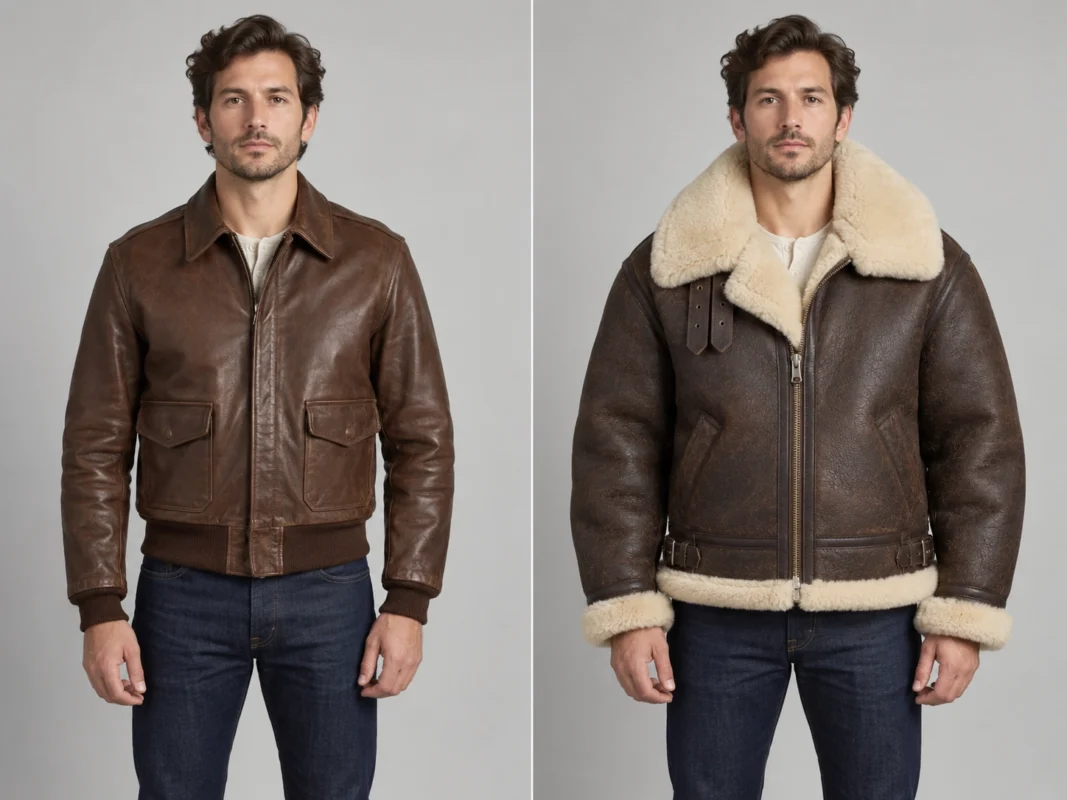
Warmth isn’t close. The B-3’s shearling lining outperforms the A-2’s original lightly-lined build by a wide margin, because it had to – the altitude and mission demanded it. Mobility flips the other way. The A-2’s trim cut and one-piece back let a pilot reach a control stick without the jacket fighting him; the B-3 trades that mobility straight back for warmth. Weight follows the same logic – the A-2 is genuinely light enough to wear all day indoors and out, while the B-3 sits closer to a heavy coat than a jacket, full stop.
Versatility is where the gap really opens up. The A-2’s slimmer profile layers under a sweater or over a shirt with zero drama. The B-3 resists layering almost by design; there’s simply not enough room in the cut, and that’s before you account for the collar. Try wearing a B-3 into a car, an office, or a crowded train, and you’ll understand within minutes why it stayed strictly a flight jacket for as long as it did – it was never meant to move through daily life the way the A-2 was.
Break-in behaves differently, too. Horsehide fights you at first and then rewards patience; shearling is comfortable almost immediately but demands more careful handling to keep the wool from matting or the leather from drying out.
Which One Fits Modern Life? A Practical Decision Guide
Choose the A-2 if:
- You want something that handles everyday cold – commuting, city winters, layering over a knit.
- You prefer a tailored, classic silhouette that works with jeans, chinos, or something a little sharper.
- You’ll wear it indoors sometimes and don’t want to sweat through a meeting.
Choose the B-3 if your winters are genuinely severe, or you specifically want maximum warmth as a style statement rather than a daily basic – in which case the bulk is a feature, not a flaw, and you should lean into it rather than fight it.
Body type matters more than most buying guides admit. The A-2’s trim, waist-length cut flatters most builds and adapts across seasons in cooler climates without much fuss. The B-3 is a committed cold-weather piece – it’ll swallow a slighter frame and demand a confident stance to wear well. Either way, get the sizing right before you commit; a jacket built this precisely doesn’t forgive a guess, and it’s worth walking through a proper leather jacket size guide before you order, especially online.
Climate should override style preference more often than it does. Someone in a mild coastal city who buys a B-3 for the look will end up wearing it four days a year, unbuttoned, sweating slightly. Someone in genuine continental cold who buys an A-2 for the silhouette will end up layering a parka over it by December anyway. Buy for the winters you actually have, not the ones in old photographs.
Styling Both Jackets Today
The A-2 pairs naturally with denim, chinos, or a flannel underneath – it moves easily between rugged-casual and smart-casual without looking like it’s trying too hard. Seal-brown is the historically correct colorway, and there’s a real case for sticking with seal-brown leather jackets if you want the silhouette to read as authentic rather than costume. There’s a full rundown on styling a brown leather jacket if you want outfit-specific direction instead of general principles.
The B-3 wants restraint. Solid base layers, sturdy boots, minimal competing outerwear details – let the collar and the bulk carry the look instead of fighting it with extra texture. Adding scarves, hoods, or a second heavy layer on top usually backfires; the jacket is already doing more visual and thermal work than almost anything else in a wardrobe, and it doesn’t need help.
Both silhouettes remain genuinely popular in modern menswear and womenswear as heritage pieces, not costume replicas, which is a big part of why demand keeps climbing: men’s leather outerwear alone accounts for more than half of global leather goods spending in 2026, and flight-jacket silhouettes are a meaningful chunk of that. Women’s fits of both jackets have also moved well past the “borrowed from the boys” phase, with cuts tailored specifically to a narrower shoulder line and shorter torso rather than just resized men’s patterns.
One practical note before you wear either one hard: fresh horsehide arrives stiff, and shearling needs different handling than smooth leather. If your A-2 feels like cardboard out of the box, there’s a real process for breaking in stiff horsehide without wrecking the grain. And whichever jacket you land on, keeping the leather clean properly – rather than just wiping it down when it looks dirty – is what actually gets you decades out of it instead of years.
FAQs
Was the A-2 jacket ever worn by bomber crews?
Occasionally, but it was mostly issued to fighter pilots and lower-altitude crews. It wasn’t built for the cold that high-altitude bomber missions actually demanded.
Why doesn’t the A-2 have hand-warmer pockets?
Military designers wanted a pilot’s hands visible and out of his pockets for a professional bearing in the cockpit. It’s a small detail that tells you a lot about the jacket’s priorities.
Is the B-3 too warm for everyday wear?
For most climates, yes. Its shearling lining was engineered for extreme high-altitude cold, and that’s exactly what makes it impractical the other 300 days a year.
Which jacket is more versatile for daily use?
The A-2, by a wide margin – lighter weight, slimmer fit, and it actually layers with the rest of your wardrobe instead of fighting it.
When was the A-2 officially replaced?
It was declared Limited Standard in 1943 in favor of nylon-shell jackets, then reissued to U.S. Air Force pilots decades later after renewed demand brought it back into service.
What’s the main material difference between the two?
The A-2 uses horsehide or goatskin leather. The B-3 uses full sheepskin with the wool left in for insulation – leather and lining in one hide.
Which jacket has a more tailored, modern-friendly silhouette?
The A-2, thanks to its trim cut and knit cuffs and waistband. The B-3 is intentionally bulkier, and no amount of tailoring changes that without ruining what makes it a B-3.
Can you wear a B-3 in a mild climate without regretting it?
Only in short bursts. The shearling lining is doing exactly what it was built to do at 25,000 feet, and at street level in mild weather, that means overheating fast – save it for genuinely cold days rather than everyday wear.